

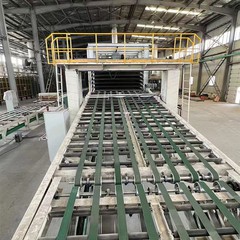
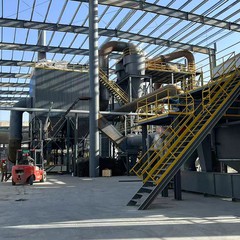
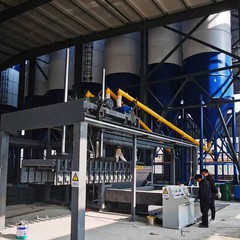
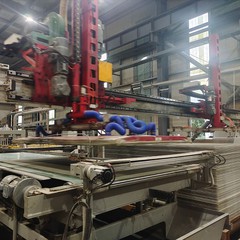
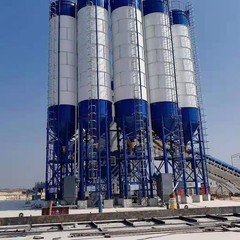



Hey there! I'm a supplier of Fireproof Gypsum Board Production Line, and today I wanna talk about how to test the moisture - resistance of fireproof gypsum boards produced by a production line.
First off, let's understand why testing moisture - resistance is crucial. Fireproof gypsum boards are commonly used in various building applications, from residential homes to commercial buildings. In environments with high humidity, like bathrooms, kitchens, or basements, these boards can be exposed to moisture. If they don't have good moisture - resistance, they can swell, deform, or even support the growth of mold and mildew, which not only affects the appearance but also the structural integrity and indoor air quality of the building.
1. The Visual Inspection Method
The simplest way to start testing the moisture - resistance of fireproof gypsum boards is through a visual inspection. Once the boards are off the Fireproof Gypsum Board Production Line, take a close look at their surfaces. A high - quality fireproof gypsum board with good moisture - resistance should have a smooth, even surface. Any signs of discoloration, such as dark spots or patches, could indicate potential moisture issues during the manufacturing process or storage.
Also, check the edges of the board. If the edges are rough or show signs of crumbling, it might be a sign that the board is more vulnerable to moisture penetration. A well - made board should have clean, sharp edges that are less likely to absorb water.
2. The Water Absorption Test
This is a classic test to measure the moisture - resistance of fireproof gypsum boards. Here's how you do it:
- First, cut several samples from the fireproof gypsum boards produced by your line. Make sure the samples are of a consistent size, say 100mm x 100mm.
- Weigh each sample accurately using a precision scale. Record the initial weight of each sample.
- Then, immerse the samples in a container filled with clean water at room temperature. Make sure the samples are fully submerged, and there's enough water to cover them completely.
- Leave the samples in the water for a specific period, usually 24 hours. During this time, the boards will absorb water if they're not well - protected against moisture.
- After 24 hours, take the samples out of the water. Wipe off any excess surface water gently with a dry cloth.
- Weigh the samples again. The difference between the initial weight and the final weight is the amount of water absorbed by the board. Calculate the water absorption rate by dividing the weight of the absorbed water by the initial weight of the sample, and then multiplying by 100 to get a percentage.
A lower water absorption rate indicates better moisture - resistance. For fireproof gypsum boards used in high - humidity areas, you'd want the water absorption rate to be as low as possible, ideally below 10%.
3. The Humidity Chamber Test
If you want a more comprehensive test that simulates real - world humidity conditions, the humidity chamber test is the way to go.
- Place the fireproof gypsum board samples in a humidity chamber. You can control the temperature and relative humidity inside the chamber.
- Set the chamber to a high relative humidity level, say 90% or more, and a temperature of around 25 - 30°C, which are typical conditions in a humid environment.
- Leave the samples in the chamber for a certain period, usually a few weeks. During this time, monitor the boards regularly for any changes.
- Check for signs of swelling, warping, or delamination. If the boards start to show these signs, it means their moisture - resistance is not up to par.
This test gives you a better idea of how the fireproof gypsum boards will perform over an extended period in a high - humidity environment.
4. The Mold Growth Test
Mold growth is a major concern when it comes to moisture - exposed gypsum boards. To test the mold - resistance of fireproof gypsum boards produced by your line:
- Prepare a nutrient - rich agar medium in petri dishes. This medium will provide a food source for the mold.
- Place small pieces of the fireproof gypsum board samples on the agar medium in the petri dishes.
- Introduce a small amount of mold spores onto the samples. You can use common mold species found in indoor environments.
- Seal the petri dishes and keep them in a warm, humid environment, like an incubator set at 25 - 30°C and high relative humidity.
- Observe the samples over a few days to a week. If mold starts to grow on the samples, it indicates that the boards are not resistant enough to moisture to prevent mold growth.
The Role of the Production Line in Moisture - Resistance
As a supplier of Fireproof Gypsum Board Production Line, I know that the production process plays a huge role in the moisture - resistance of the final product.


- Raw Materials: Using high - quality raw materials is essential. For example, the gypsum powder should be pure and free from impurities. Some additives can also be used during the production process to enhance moisture - resistance.
- Mixing and Forming: The way the gypsum mixture is prepared and formed on the production line is crucial. A well - mixed and evenly formed board will have better internal structure, which can improve its moisture - resistance.
- Drying Process: The drying process on the production line should be carefully controlled. If the boards are not dried properly, they can retain moisture, which will affect their long - term moisture - resistance.
Other Production Lines and Their Benefits
We also offer a range of other production lines that might interest you. For instance, the Automatic Paperless Gypsum Board Production Line provides high - efficiency production with less manual intervention. It can produce gypsum boards with consistent quality, which is important for ensuring good moisture - resistance.
The Waterproof Gypsum Board Production Line is specifically designed to produce boards with excellent water - and moisture - resistance. It uses special manufacturing techniques and additives to make the boards more suitable for wet areas.
The High Strength Gypsum Board Production Line focuses on producing boards with high mechanical strength, which can also contribute to better moisture - resistance as stronger boards are less likely to deform when exposed to moisture.
And if you're on a budget or need a more flexible production solution, the Semi - automatic Paperless Gypsum Board Production Line is a great option. It combines some manual operations with automated processes to offer a cost - effective way to produce gypsum boards.
Conclusion
Testing the moisture - resistance of fireproof gypsum boards produced by a production line is essential to ensure their quality and performance in different environments. By using methods like visual inspection, water absorption test, humidity chamber test, and mold growth test, you can accurately assess the moisture - resistance of the boards.
As a supplier of Fireproof Gypsum Board Production Line and other related production lines, we're committed to helping you produce high - quality gypsum boards. Whether you're looking to improve the moisture - resistance of your products or increase your production efficiency, we have the right solutions for you. If you're interested in learning more about our production lines or have any questions regarding the production and testing of gypsum boards, feel free to reach out and start a procurement discussion.
References
- ASTM C473 - Standard Test Methods for Physical Testing of Gypsum Panel Products
- ISO 291:1997 - Plastics — Standard atmospheres for conditioning and testing