

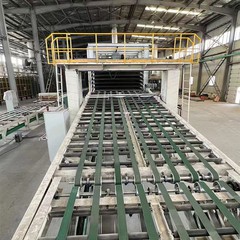
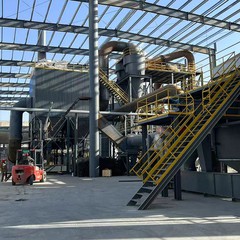
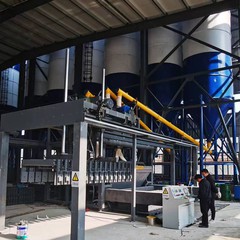
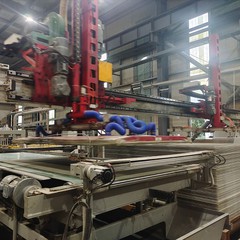
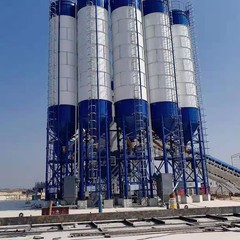





Shineye Mach Co., Ltd. is one of the leading manufacturers and suppliers of Semi Automatic Paperless Gypsum Board Production Line in China. If you're going to buy the newest Semi Automatic Paperless Gypsum Board Production Line made in China, welcome to get quotation from our factory. All customized products are with high quality and competitive price.
A Practical Entry Point for Paperless Gypsum Board Manufacturing
This production line processes gypsum powder with glass fiber and additives to produce paperless fiber-reinforced boards for construction and decorative applications. Unlike traditional paper-faced drywall, paperless boards offer better moisture resistance, higher strength-to-weight ratio, and eliminate paper waste-making them increasingly popular in humid environments and green building projects. The line operates at 20,000–100,000 m²/year, produces boards 6–20mm thick and 1220mm wide, with 50-70% automation-automating mixing, forming, and drying while keeping feeding and stacking manual. This configuration offers energy-efficient drying, consistent quality, and reduced labor compared to manual production, making it ideal for first-time manufacturers, budget-conscious operations, and facilities with limited workshop space.

Key Features
This semi-automatic paperless line offers six key advantages for small and medium manufacturers:
| Feature | Benefit |
|---|---|
| Moderate investment | Lower capital entry point compared to fully automatic lines |
| Compact footprint | Fits into 500–1,500 m², works in existing workshops |
| Automated mixing and forming with fiber addition | Consistent quality for paperless boards where fiber distribution is critical |
| Controlled drying | Energy-efficient, temperature and time automatically regulated |
| Manual feeding and stacking | Flexible for small batches and changing orders |
| Future automation upgrade | Designed to grow with your business |
Beyond the equipment itself, this semi-automatic paperless configuration delivers two additional operational advantages: labor efficiency-4–6 operators per shift vs 10–15 for manual production, reducing labor costs significantly; and quick training-3–5 days to proficiency, with on-site training included.
Production Process
Raw Material Feeding → Fiber Addition → Mixing → Forming → Drying → Cutting → Stacking → Packaging
| Step | Description | Automation |
|---|---|---|
| 1. Raw Material Feeding | Gypsum powder and additives are manually weighed and fed into the system | Manual |
| 2. Fiber Addition | Glass fiber or other reinforcing fibers are added to the mix-critical for paperless board strength | Manual/Semi-automatic |
| 3. Mixing | The automatic mixer blends powder, fiber, additives, and water into a consistent slurry | Automatic |
| 4. Forming | The semi-automatic forming machine compacts and shapes the fiber-reinforced boards | Semi-automatic |
| 5. Drying | Boards pass through a temperature-controlled dryer | Automatic |
| 6. Cutting | An automatic cutter trims boards to specified length | Automatic |
| 7. Stacking | Finished boards are manually stacked and organized | Manual |
| 8. Packaging | Boards are manually packed and prepared for shipment | Manual |
Operator training is provided on-site during commissioning. Most operators become proficient within 3–5 days.
Product Images


Technical Specifications
| Parameter | Specification |
|---|---|
| Annual output | 20,000 – 100,000 m²/year |
| Board thickness | 6 – 20 mm |
| Board width | 1,220 mm (standard) |
| Board length | Adjustable via cutting system |
| Automation level | 50% – 70% semi-automatic (depending on configuration) |
| Power consumption | 30 – 80 kW |
| Voltage | 380V/50Hz (customizable) |
| Compressed air | 0.6 – 0.8 MPa |
| Floor space required | 500 – 1,500 m² |
| Raw material consumption | Approximately 8–10 kg per m² of finished board (including fiber) |
| Operators per shift | 4–6 |
| Training time | 3–5 days |
Investment ranges from $50,000 to $150,000 depending on configuration. Final price depends on capacity, board specifications, automation level, dryer configuration, and selected options. A detailed quotation is provided after requirements are defined.
What This Line Produces - Paperless Fiber-Reinforced Boards
| Property | Specification |
|---|---|
| Board Type | Paperless/fiber-reinforced gypsum board (no paper facing) |
| Reinforcement | Glass fiber or other reinforcing fibers integrated into the core |
| Key Advantages | Moisture-resistant, lightweight, high strength, good sound insulation |
| Typical Applications | Bathrooms, basements, kitchens, decorative panels, green building projects |
| Surface Finish | Can be painted or finished directly-no paper to peel or blister |
The forming section is specifically configured for fiber-reinforced formulations. The fiber dosing system ensures even distribution throughout the slurry-critical for consistent board strength.
Who Is This Production Line For?
This entry-level paperless production line is specifically suited for four types of manufacturers:
| Customer Type | Rationale |
|---|---|
| Start-up manufacturers | Lower capital entry, quicker payback, straightforward operation |
| Small and medium factories | 20,000–100,000 m²/year capacity matches their scale |
| Existing workshop owners | Compact footprint fits into 500–1,500 m² without major building modifications |
| Manufacturers upgrading from manual production | Significant quality and efficiency improvement over manual paperless lines |
Paperless vs Paper-Faced Gypsum Board - Why Go Paperless?
| Comparison | Paperless Board | Paper-Faced Board |
|---|---|---|
| Moisture resistance | Superior - no paper to absorb moisture | Limited - paper facing can degrade in high humidity |
| Strength-to-weight ratio | Higher - fiber reinforcement provides structural integrity | Standard - strength depends on core density |
| Surface finishing | Can be painted directly; no paper joints to tape | Requires taping and joint compound |
| Waste | No paper waste; fully recyclable | Paper waste generated during production and installation |
| Fire resistance | Comparable | Comparable |
| Cost | Slightly higher raw material cost | Lower raw material cost |
| Best applications | Bathrooms, basements, kitchens, commercial interiors | Standard interior walls and ceilings |
The paperless gypsum board produced by this line offers significant advantages for moisture-prone environments and green building certification requirements. For manufacturers targeting these markets, the fiber-reinforced board commands a premium price.
Semi Automatic vs Fully Automatic (Paperless Focus)
| Comparison | Semi Automatic | Fully Automatic |
|---|---|---|
| Capital investment | Lower (typical entry-level) | Higher (significant capital) |
| Annual capacity | 20,000 – 100,000 m² | 1.5M – 30M m² |
| Operators per shift | 4–6 | 2–3 |
| Automation level | 50-70% | 95%+ |
| Fiber addition method | Manual/Semi-automatic | Fully automatic dosing |
| Feeding method | Manual | Automatic |
| Stacking method | Manual | Automatic |
| Best for | Startups, small/medium paperless manufacturers | Large-scale industrial production |
| Upgrade path | Add automation modules later | N/A |
The semi-automatic paperless line serves as an entry point for manufacturers planning to expand in the paperless board market. For higher capacity requirements, see our <a href="/gypsum-board-production-line/full-automatic-machine-making-paper-faced.html">fully automatic gypsum board production line</a> (can be configured for paperless production with fiber dosing system). When demand increases, automatic fiber dosing, feeding, and stacking can be added without replacing the entire system.
Equipment Configuration
A complete semi automatic paperless gypsum board production line includes the following equipment:
| Equipment | Function | Automation |
|---|---|---|
| Raw material hopper | Stores gypsum powder for feeding | Manual feed |
| Fiber dosing station | Adds glass fiber to the mix | Manual/Semi-automatic |
| Screw conveyor | Transports powder to mixer | Electric drive |
| Continuous mixer | Blends powder, fiber, additives, and water into slurry | Automatic |
| Mold conveyor | Moves molds through forming section | Semi-automatic |
| Forming machine | Compacts and shapes fiber-reinforced boards | Semi-automatic |
| Board conveyor | Transfers formed boards to dryer | Electric drive |
| Multi-zone dryer | Removes moisture gradually | Automatic |
| Auto cutter | Trims boards to specified length | Automatic |
| Manual stacking table | Board stacking and quality inspection | Manual |
| Control panel | PLC with HMI for process control | Semi-automatic |
Applications for Paperless Gypsum Boards
| Application | Description |
|---|---|
| Residential construction | Bathrooms, basements, kitchens, laundry rooms |
| Commercial buildings | Restrooms, commercial kitchens, locker rooms |
| Decorative panels | Interior wall panels with direct paint finish |
| Moisture-resistant areas | High-humidity environments where paper-faced boards fail |
| Green building projects | LEED and other certification requirements |
| Renovation projects | Small batch production for specific job requirements |
Engineering & Manufacturing Capability

Founded in 2002, with gypsum board equipment production beginning in 2008, Hebei Xiangyi Mechanical Co., Ltd. has supplied equipment to more than 60 countries, including semi-automatic paperless lines for small and medium manufacturers. Since our first semi-automatic gypsum board production line launched in 2012, we have served more than 1,000 customers worldwide. In 2018, we expanded our production base and introduced advanced processing equipment to improve product quality and stability. The facility currently covers 25,000 m² with 50+ sets of processing equipment and over 100 employees.
Engineering team: The engineering department includes senior mechanical, electrical, and process engineers. Design, fabrication, assembly, testing, and commissioning are handled in-house.
Manufacturing capability:
-
CNC cutting and forming for precision structural components
-
Certified welding and fabrication
-
Machining of critical components (mixer shafts, roller bearings, knife hubs)
-
Sub-assembly of major sections before shipping
-
Control panel fabrication and programming

Quality control: An in-house testing lab performs gypsum sample analysis and equipment verification. Customers may visit the facility to witness testing before shipment.
Product range: Product range includes gypsum board lines, <a href="/gypsum-board-production-line/full-automatic-machine-making-paper-faced.html">fully automatic gypsum board production lines</a>, calcium silicate board lines, fiber cement board lines, block lines, and dry mortar stations.
Certifications:
1. ISO 9001:2015 Quality Management System
2. CE certification for EU market
3. GB/T 9775-2008 product standard compliance
4. In-house test reports for custom verification

Project References
The following configurations represent projects delivered to customers across different regions.
| Region | Year | Capacity | Board Type | Configuration Highlight |
|---|---|---|---|---|
| Southeast Asia | 2022 | 50,000 m²/year | Paperless | Compact layout for limited workshop space |
| Africa | 2023 | 80,000 m²/year | Paperless | Gas-fired dryer, configured for quick installation |
| West Africa | 2024 | 100,000 m²/year | Paperless | Coal-fired dryer, upgrade-ready design |
| Southeast Asia | 2023 | 40,000 m²/year | Paperless | LPG-fired dryer, smallest footprint |
| Central Asia | 2024 | 60,000 m²/year | Paperless | Natural gas dryer, flexible thickness range |
Parameters can be adjusted to match specific requirements. Detailed project references and photos are available upon request.
Services
| Stage | Support Provided |
|---|---|
| Before purchase | Free consulting, on-site planning, line customization |
| Installation | Technical staff for setup and commissioning |
| Training | Free on-site training for 4–6 operators (3–5 days) |
| Warranty | 12 months on manufacturing defects |
| Spare parts | Priority supply - emergency parts ship within 24 hours |
| Long-term support | Phone and email support for the life of the line |
| Formula assistance | Help with fiber and additive adjustments for different paperless board formulations |
Support relationships are maintained beyond the warranty period.
Frequently Asked Questions
Q: 1. What is a semi automatic paperless gypsum board production line?
A: A semi automatic paperless gypsum board production line automates the critical production steps-mixing fiber-reinforced slurry, forming, and drying-while manual tasks like material feeding and board stacking are performed by operators. Designed for 20,000–100,000 m²/year, it produces paperless fiber-reinforced boards at a significantly lower investment than fully automatic lines. First-time manufacturers and companies targeting moisture-resistant board markets are the primary users.
Q: 2. How does a semi-automatic paperless line differ from a paper-faced line?
A: The key difference is the fiber addition system. Paperless boards require glass fiber or other reinforcing fibers to be evenly distributed throughout the slurry-this line includes a fiber dosing station. Paper-faced lines use paper as the structural facing and don't require fiber addition. The forming section is also configured differently for fiber-reinforced formulations.
Q: 3. What are the advantages of paperless gypsum boards?
A: Paperless boards offer superior moisture resistance, higher strength-to-weight ratio, and eliminate paper waste. They can be painted directly without taping paper joints, making them ideal for bathrooms, basements, kitchens, and green building projects. They command a premium price in moisture-prone markets.
Q: 4. How much floor space is required?
A: Typically 500–1,500 m², depending on capacity. Minimum dimensions: 20–40m length, 10–15m width, 4–5m height. Dimensioned layout drawings are provided before ordering.
Q: 5. How many operators are needed per shift?
A: A semi-automatic paperless line typically requires 4–6 operators per shift, including material handling, fiber addition, and board stacking. This is more than a fully automatic line (2–3 operators), but significantly less than manual production (10–15 operators).
Q: 6. Can the line be upgraded to fully automatic later?
A: Yes-the line is built with modular components and space for future automation. Automatic fiber dosing, feeding systems, stacking equipment, and other automation modules can be added as production scales. This allows entry with lower capital and expansion over time without replacing the entire system.
Q: 7. What is the typical installation and startup timeline?
A: Total timeline from equipment arrival to full production: approximately 6–10 weeks. Installation takes 2–4 weeks, system connections 1–2 weeks, commissioning 1–2 weeks, and operator training 3–5 days. Technical personnel are on-site to guide the process.
Q: 8. What training is included?
A: Free on-site training for 4–6 operators is provided during commissioning. Training covers material preparation, fiber addition technique, machine operation, quality inspection, basic maintenance, and troubleshooting. Most operators become proficient in 3–5 days.
Q: 9. What fuel options are available for the dryer?
A: The dryer accepts coal, natural gas, LPG, or fuel oil. Burner selection depends on local fuel availability. Natural gas is the cleanest and lowest maintenance option. Coal-to-gas convertible burners are available for plants with uncertain fuel economics.
Q: 10. What information is needed for a quotation?
A: Gypsum type (natural, FGD, phosphogypsum, or blended), target annual capacity, board thickness and width range, available fuel source, and workshop dimensions. A 5kg gypsum sample for testing is recommended to ensure the line is configured for the specific material and fiber formulation.
Request a Quotation
Semi automatic paperless gypsum board production lines are engineered for consistent output, manageable investment, and future expansion. Browse our full range of <a href="/gypsum-board-production-line/gypsum-board-production-equipment.html">gypsum board production equipment</a> for more options. Send your gypsum type, target capacity, and local fuel availability for a configuration recommendation and detailed quotation with lead times.
Our address
North of Dongzicheng Village, Circular Economy Industrial Zone, Jinzhou City, Hebei Province, China
Phone Number
+86 18132648037
xiangyijixielucia@yeah.net
