

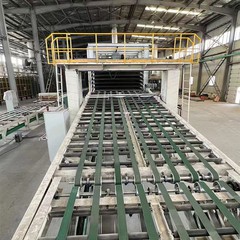
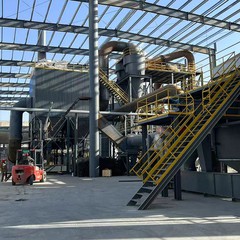
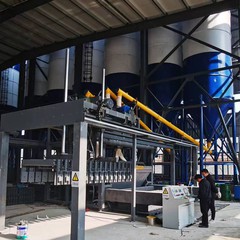
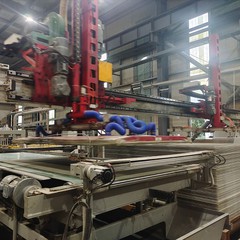
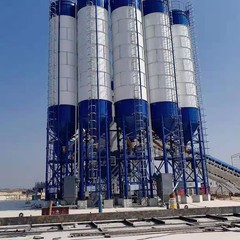





Shineye Mach Co., Ltd. is one of the leading manufacturers and suppliers of Gypsum Board Production Equipment in China. If you're going to buy the newest Gypsum Board Production Equipment made in China, welcome to get quotation from our factory. All customized products are with high quality and competitive price.
Gypsum Board Production Equipment

How Production Line Design Determines Plant Profitability
Achieving stable drywall production requires more than just connecting machines. Plant profitability depends on production stability, operating cost, energy consumption, and maintenance. A line at 92% efficiency makes money. One at 70% burns capital.
This page explains how line design affects board quality and how different configurations match different gypsum materials. We've been building these systems since 2002, with installations in over 20 countries.
How to Choose the Right Capacity
Capacity selection is critical. Too small limits growth. Too large ties up capital you may not fully utilize.
3 million m²/year
Regional Manufacturer. First-time entrants, single-shift. Lower capital, simpler installation, higher unit cost. Roughly 10 million standard boards annually.
5 million m²/year
Mid-Size Producer. Most common. Balances capital with operating efficiency. Runs two or three shifts. Fits most growing manufacturers.
10 million m²/year
Export Manufacturer. For multiple countries or large domestic markets. Fuel consumption per m² is 5-10% lower than 5M lines. Requires consistent gypsum supply.
20 million m²/year
Large Industrial Group. Continuous operation-8,000 hours/year. Each 1% energy saving is worth $300,000-$400,000 annually.
If unsure about future demand: start with 5M but design building for 10M. Incremental cost is small-building new later costs everything.
How Production Stability Varies Between Plants
| Operational Challenge | Conventional Practice | Recommended Design |
|---|---|---|
| Changing board thickness | Line stop; manual (1-2 hrs) | HMI control; line continues (2-3 min) |
| Feedstock moisture variation | Operator manual check | Online analyzer every 30 seconds |
| High drying fuel costs | Exhaust vented to atmosphere | Heat recovery: 8-12% energy capture |
| Forming plate wear (3 shifts) | Carbon steel: 2-3 years | Stainless steel: 8-10 years |
| Paper roll change | Manual splicing; line stop | Optional automatic splicer |
| Recipe changes | Manual reconfiguration | PLC with 50+ stored recipes |
| Limited on-site technical support | Call technician; wait days | Remote monitoring; real-time diagnostics |
A 12-hour stop on a 5M line costs $5,000-$10,000. Stainless plate eliminates 2-3 stops per decade. Heat recovery saves $400,000-$600,000 annually. A $15,000-$20,000 moisture analyzer typically pays for itself within the first year through reduced rejects.
Process Control - Why Board Quality Changes
Board quality doesn't vary randomly. Every variation traces to a specific section of the line.
Density Control
Set at the weighing hopper and mixer. Hopper accuracy: ±0.5%. A 1% drift changes density by 0.6 kg/m² on 9mm board-enough to push boards below spec. Water accuracy: ±1%. A 0.1% change in water-to-powder ratio shifts setting time by 30 seconds, causing edge tearing.
Where it goes wrong: Hopper drift, water meter clogging, silo bridging, operator overcorrection.
How we address it: Digital load cells with auto zero tracking. Strainers with differential pressure gauges. Aeration pads at silo discharge.
Thickness Control
Set at the forming station. Once the board leaves, you cannot change it. Plate worn 0.05mm produces boards thicker in the middle. Edge guide misalignment of 1.5mm creates uneven edges customers reject.
Where it goes wrong: Slurry buildup on plate edges, edge guide wear, vibration misalignment, paper tracking off-center.
What we do differently: Accessible plate edges for cleaning. Hardened steel edge guides with 5mm wear allowance. Ball screw adjustment. Paper tracking sensors alarm at 2mm off-center.
Moisture Management
Managed at the mixer and dryer. Most quality issues trace to water addition. A moisture analyzer measuring every 30 seconds-up to 2,880 readings per day-removes operator guesswork. When FGD gypsum arrives wetter, the analyzer reduces water addition automatically. Without it, moisture changes go unnoticed until you have a belt full of off-spec board.
Where it goes wrong: Feedstock moisture varies seasonally. Dosing pumps lose calibration. Mixer paddles wear unevenly. Operators overcorrect.
Recommended practice: Dosing pumps with flow verification alarms. Reversible mixer paddles. Online moisture analyzer eliminating operator guesswork.
Surface Quality & Energy
Blistering occurs when surface moisture evaporates too quickly. Warping occurs when one surface dries faster than the other.
Key failure points: Temperature varies across dryer width. Fan blades erode. Burner nozzles foul. Stacker programming errors.
Preventive measures: Three sensors per zone (left, center, right). Alarm at 15°C difference. Wear indicators on fan blades-replace at ~20% wear. Remote grease lines for bearings. Preset stacking patterns.
Energy impact: Drying is the largest operating expense-20-35% of total production cost. Heat recovery captures 8-12% of exhaust energy. On a 5M line at $0.50/Nm³, annual savings potential is roughly $1 million. Payback typically 18-24 months.
Common Mistakes When Buying
Based on 60+ countries and 20+ years of installations, these are the most expensive mistakes.
Buying based only on line speed. A 12 m/min line at 92% uptime produces more than a 15 m/min line at 80% uptime. Ask about downtime, changeover time, and maintenance frequency.
Ignoring gypsum quality variation. Equipment specified for the best sample struggles with normal variation. We test setting time, water demand, purity, particle size-and design for worst-case, not best-case.
Ignoring dryer energy cost. Dryer accounts for 20-35% of production cost. Heat recovery saves $400,000-$600,000/year on a 5M line. Choosing without it to save $150,000 upfront costs millions over a decade.
Choosing equipment without considering expansion. Extra building length costs little now. Building a new facility later costs everything. Design building and foundation for future capacity from the start.
Ignoring local fuel availability. A natural gas line cannot run on coal without major burner replacement. Specify actual and backup fuel sources during design. Coal-to-gas convertible burners available.
Which Gypsum Material Does This Equipment Support?
Natural gypsum
(0.5-1.5% moisture)-standard single-shaft mixer. Moisture analyzer optional but beneficial for multi-source supply.


environment-friendly
(2-15% moisture)-online moisture analyzer is essential. Without it, reject rates increase significantly. Not optional.
Phosphogypsum
(contains acids, impurities)-stainless steel (304 or 316) for all wetted components. Pre-washing system recommended.


Blended synthetic
analyzer-equipped mixer with expanded additive dosing and multiple recipes. Operators select recipe based on current blend ratio.
Switching sources in future
design for the most challenging material. Adding analyzer or stainless later costs more. Configure recipes for all possible materials.


How to determine the right configuration
Send a 5 kg sample. We test setting time, water demand, purity, impurities, and particle size. Results tell us the right configuration. Testing first is the only reliable way to avoid incorrect specification.
Engineering Experience - Key Learnings
Climate-specific design: Hot climates (Kuwait, 50°C) require additional cooling and modified burner settings. Cold climates (Belarus, -30°C) require insulated water lines and startup procedures. Humid climates (Indonesia, 90% RH) require dehumidification in raw material storage.
Power and fuel variation: Unstable grid requires isolation transformers. Fuel switching requires coal-to-gas convertible burners. Limited power requires careful motor sizing.
Products Description
Remote monitoring added.60+ countries served.
Heat recovery introduced.
Calcium silicate board equipment added.
Single project engineering. Stopped offering "standard" lines.
Facility expanded to 25,000 m².
Siemens PLC controls introduced.
Bangladesh, Belarus, Kuwait, Russia. Built climate modification library.
First Central Asia installation (Tajikistan). Learned "standard" configurations don't exist.
First export to Pakistan (6M m²/yr).
Founded in Hebei.
Procurement Decision Guide - FAQ
Q: 1. At which stage should the building foundation be completed?
A: Before equipment arrives-but not before layout drawing is finalized. We deliver dimensioned drawings before you order. Start foundation work as soon as you approve them. If foundation is ready when equipment arrives, installation takes 2-3 months. If not, equipment sits in containers while you pour concrete.
Q: 2. How do I verify whether locally sourced paper is suitable?
A: Test three properties: tensile strength (tearing causes stops), moisture absorption (blistering), width consistency (1mm variation causes edge issues). We can test your paper samples before you commit. Testing is free.
Q: 3. Which operating cost has the biggest influence on ROI?
A: Drying fuel-20-35% of total production cost. Heat recovery captures 8-12% of exhaust energy, saving $400,000-$600,000/year on a 5M line at $0.50/Nm³. Payback typically 18-24 months.
Q: 4. What information should I prepare before contacting a supplier?
A: Gypsum type, target capacity, building dimensions, fuel availability, operator experience. Most valuable: send 5 kg gypsum sample for testing. Without it, recommendations are generic. With it, we engineer a line specific to your material.
Q: 5. What's the most common mistake first-time buyers make?
A: Under-estimating building length. Six-zone dryer needs 55-65 meters-total production floor: 80-90 meters minimum. Second: not budgeting for spare parts. A $500 PLC power supply takes 5-10 days to ship. The line stop costs $5,000-$10,000.

Before Requesting a Quotation
Prepare several basic parameters: gypsum type, annual capacity, board thickness range, local fuel source, and workshop dimensions. This allows engineers to recommend a suitable configuration and estimate utility consumption accurately.
Most valuable step: send 5 kg gypsum sample for testing. Setting time, water demand, purity, and particle size directly affect belt length, mixer speed, dryer profiles, and plate material. Without this test, recommendations are generic. With it, we engineer a line specific to your material.
Request a Quotation
Our gypsum board production equipment is built for consistent output, minimal stops, and predictable operating costs. Send us your gypsum type, target capacity, and local fuel availability. We'll recommend the right configuration with lead times.
Our address
North of Dongzicheng Village, Circular Economy Industrial Zone, Jinzhou City, Hebei Province, China
Phone Number
+86 18132648037
xiangyijixielucia@yeah.net
Contact: Jessica Li | Response within 24 hours. Gypsum sample testing available upon request.
