

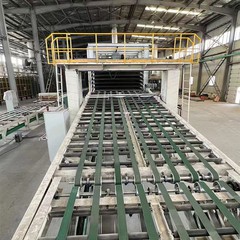
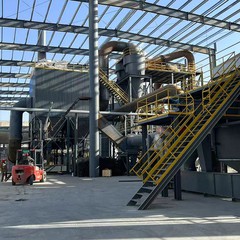
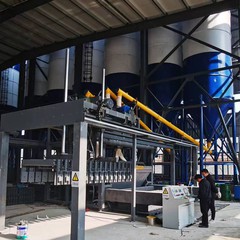
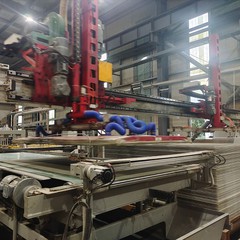
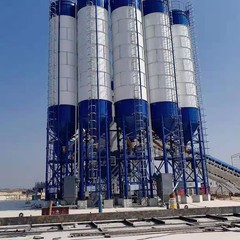





Shineye Mach Co., Ltd. is one of the leading manufacturers and suppliers of Gypsum Board Production Line Equipment in China. If you're going to buy the newest Gypsum Board Production Line Equipment made in China, welcome to get quotation from our factory. All customized products are with high quality and competitive price.
Gypsum Board Production Line Equipment

Quick Answer
You call three suppliers and get three different quotes. Each one claims they have the best equipment. But the real question is not who has the lowest number on a piece of paper. It is whose machine actually runs when it arrives. Whose team shows up to install it. Whose phone number still works after six months of production.
We have seen customers buy from trading companies and end up with lines that simply do not work. The trader says "I will check with the factory" and then disappears for weeks.
This line is built by our factory, installed by our team, and backed by our engineers. You pay for the machine itself-not a markup for a trading company. Direct. Transparent. No third party to slow things down.
Original Plant Producing Gypsum Board Production Line Equipment means you are paying for the machine, delivered and commissioned by the people who built it.
What This Line Produces
Gypsum powder, water, and additives go into one end. Finished paper-faced boards come out the other, stacked and ready to ship.

Board specifications:
Thickness: 7 – 15mm adjustable
Width: 1200mm or 1220mm
Length: 1800 – 4000mm adjustable
Density: 600 – 800 kg/m³
Standard: GB/T9775-2008 (equivalent to ASTM C1396 for export)

Key features:
PLC automatic control with HMI touchscreen
Drying thermal efficiency: ≥85% with heat recovery
Supports natural and synthetic gypsum
Capacity: 1.5 – 30 million m²/year
Fuel options: coal, fuel oil, natural gas, LPG
How to Select the Right Capacity
This is the most important investment decision you will make.
| If you are... | Consider this capacity | Key considerations |
|---|---|---|
| Entering a new market, no existing customers | 2 – 5 million m²/year | Lower capital, shorter payback, learn the process |
| Growing, supplying multiple regions | 5 – 10 million m²/year | Balance cost and volume, 2-shift operation |
| Export-oriented or large contractor supply | 10 – 20 million m²/year | Competitive unit cost, 3-shift operation |
| Large industrial group, multi-country supply | 20 – 30 million m²/year | Lowest unit cost, requires established demand |
Common mistake: buying the largest line you can finance, rather than the line that matches your confirmed market. Many customers start smaller, validate demand, and add a second line later.
Three questions that tell you what you actually need:
What can you sell right now? Buy based on today's orders, not three-year projections.
How many shifts will you run? A 5 million m² line running three shifts outproduces a 10 million m² line running one shift.
What is your raw material cost? If you have cheap or free synthetic gypsum, your margin is higher-you can justify a larger line.
Factory Planning Checklist
Before you pour concrete, go through this checklist.
| Item | Recommended | Notes |
|---|---|---|
| Raw material storage | 800 – 1,500 m² | Gypsum powder silos, paper rolls, additives |
| Production workshop | 3,000 – 6,000 m² | Forming, setting, drying, cutting |
| Finished goods storage | 800 – 1,500 m² | Stacked pallets |
| Control room | 50 – 100 m² | Central PLC monitoring |
| Expansion reserve | +20-30% | Future capacity addition |
The most common layout mistake: designing the building for the forming section and then discovering the dryer does not fit. The drying kiln determines your building length-plan the building around the dryer.
Questions to Ask Before Buying
Ask these questions before signing any contract. The answers tell you who you are really dealing with.
| Question | Why it matters | What a manufacturer should say |
|---|---|---|
| Who builds the equipment? | Trading companies resell; they do not manufacture | "We manufacture it in our own facility." |
| Who handles installation? | Subcontracted installers often have no experience with your specific line | "Our own team handles installation." |
| What happens if a component fails? | Some suppliers do not stock spare parts | "We stock replacement parts and ship immediately." |
| How long is the warranty? | 12 months is standard; less is a red flag | "12 months, with lifetime support." |
| What training is provided? | Some suppliers give 2 days of basic instruction | "We stay until your team can run the line independently." |
| Can I visit the factory? | If they say no, they are likely not the manufacturer | "Yes, visit our facility to see the line being built." |
Technical Specifications
| Parameter | Specification |
|---|---|
| Annual Output | 1.5 – 30 million m² |
| Line Speed | 0 – 30 m/min (varies by model) |
| Thickness | 7 – 15 mm (adjustable) |
| Width | 1200mm, 1220mm |
| Length | 1800 – 4000mm (adjustable) |
| Density | 600 – 800 kg/m³ |
| Gypsum Powder | 100 mesh |
| Paper | 170gsm, 180gsm (gray, ivory) |
| Additives | Modified starch, water reducer, white latex |
| Glue | PVA emulsion |
| Drying Method | Multi-stage kiln / heat transfer fluid heater |
| Thermal Efficiency | ≥85% |
| Fuel Options | Coal, fuel oil, natural gas, LPG |
| Total Installed Power | 100 – 800 kW (depends on capacity) |
| Floor Area Required | 1,500 – 9,600 m² |
| Required Workers | 10 – 15 per shift |
| Control System | PLC automatic control with HMI |
| Quality Standard | GB/T9775-2008 |
All specifications based on standard configurations. Actual parameters vary depending on capacity, raw materials, and site conditions.
Parameter Highlights - What Matters for Your Decision
Annual output. Actual output depends on operating hours, not just the rated capacity. A line rated for 30 million m² will not produce 30 million m² if it only runs one shift.
Line speed. Speed alone is misleading. The dryer is almost always the limiting factor. When comparing equipment, ask about dryer capacity, not just forming speed. A faster forming section without a matched dryer is wasted capacity.
Thermal efficiency. Drying consumes 60-70% of total energy. A line at 85% efficiency burns significantly less fuel than one at 80%-on a 5 million m² line, the difference is USD 50,000-80,000 per year. Compare drying system design, not just the efficiency number on the spec sheet.
Thickness and density. Thicker boards take longer to dry and consume more raw material. Lower density boards are cheaper to produce but have less strength. Your product mix determines the actual output. Plan for the thickness you will actually sell, not the maximum the line can handle.
Floor area. The drying kiln is the largest single space consumer-it runs the full length of the building. Make sure your building is long enough for the dryer, not just wide enough for the forming section.
Common Mistakes Before Investing
Buying through a trading company
Compare total delivered and installed cost-not just the machine price. The lowest quote often comes with no installation support, no spare parts, and no recourse when something goes wrong.
Undersizing the drying system
Add 15-20% buffer to the dryer during planning. Many customers focus on forming speed, but the dryer sets the production ceiling.
Ignoring local power conditions
Voltage and frequency vary by country. If the control system is not configured for your specific grid, the line will not run reliably. We configure it before shipping-but you need to tell us what it is.
Underestimating installation time
A typical line takes 4-8 weeks to install and 2-4 weeks to commission. Some customers budget 6 weeks total and are surprised when it takes 10-12. Result: idle equipment, delayed revenue, and extended debt service.
Not planning for spare parts
We provide a recommended spare parts list. Some customers order a kit with the initial purchase. Those who do not often regret it when a motor bearing fails six months in.
Skipping operator training
Do not cut training short. We stay until your team can run the line-troubleshoot, adjust thickness, and change recipes.
Production Process
| Stage | Function | Key Detail |
|---|---|---|
| Raw material feeding | Gypsum powder (100 mesh), paper (170-180gsm) | Automatic metering, continuous supply |
| Batching and mixing | Powder, water, additives, PVA glue | Measured and mixed automatically |
| Board forming | Slurry formed between paper facings | Stainless steel plate forming machine |
| Setting and cutting | Hardening on setting belt, cut to length | Flap machine and palletizing unit |
| Drying | Multi-stage kiln with layer/section temperature control | Heat transfer fluid heater, ≥85% efficiency |
| Edge trimming and inspection | Trimmed to exact width, quality checked | Thickness, density, surface finish |
| Stacking and packaging | Automatic stacking and wrapping | Ready for shipment |
Direct from the Original Plant - A Customer's Experience
A customer came to us after buying a line from a trading company. The price was lower than our quote, but the machine arrived with mismatched components. The forming section did not align with the conveyor. The control system used a different voltage than the motors. The trader's response to every issue was the same: "I will check with the factory." Three months later, the customer still had a non-functioning line. They scrapped the control system, re-purchased motors locally, and paid us to re-align the forming section. Total cost ended up higher than our original quote.
We are the factory. There is no middleman to slow things down.
| Scenario | Direct Purchase | Through a Trader |
|---|---|---|
| Electrical incompatibility | We re-wire or provide step-down transformer within 48 hours | 2-4 weeks |
| Missing component | We ship from our stock | 4-8 weeks |
| Installation question | Our installation team is on-site | Subcontractor who has never seen the machine |
| Operator training | Our engineers stay until the line runs | 2-3 days of basic instruction |
Our facility in Jinzhou stocks common spare parts-motors, bearings, sensors, PLC modules. Some customers have called us five years after installation asking for a part. We usually have it on the shelf.
We do not build the most lines per year. We build lines that stay running.
Installation Projects
| Year | Country | Capacity | Notes |
|---|---|---|---|
| 2010 | Inner Mongolia | 10 million m²/year | High-capacity line for major Chinese manufacturer |
| 2023 | Pakistan | 5 million m²/year | Infrastructure development framework |
| 2025 | Pakistan | 6 million m²/year | Local production capacity gap |
| 2026 | Southeast Asia | 5 million m²/year | Recent turnkey project |
Customer Feedback
"We were comparing quotes from three suppliers. The deciding factors were the PLC system and the drying efficiency. Two years in, we are already planning a second line." - Plant Director, Pakistan
"The line started up without issues. Our reject rate dropped from over 4% to under 1%. We are supplying boards to projects we could not have bid on before." - Production Manager, Southeast Asia
Services

Pre-sales
Free consulting. We analyze your capital, plant space, target market, and production goals. We provide detailed layout drawings and infrastructure planning.
During sales
Production follows the agreed timeline and customer specifications. We communicate progress regularly.


After-sales
12-month warranty with lifetime tracking service. Our technical team guides installation and commissioning. We provide free operation training for 2-3 operators until your line produces qualified products.
Long-term support
Ongoing technical guidance on energy-saving production. Even years after installation, we are still available for questions.

Frequently Asked Questions
Q: 1. What capacity options are available?
A: Standard configurations range from 1.5 million to 30 million square meters annually. If you are entering a new market, we usually recommend starting at 2-5 million m². It requires less capital and you can always add a second line later. If you already have contracts lined up, 5-10 million m² may be a better entry point. The right capacity depends on how many shifts you plan to run, not just the number on the spec sheet.
Q: 2. What raw materials does the line use?
A: Gypsum powder (100 mesh), facing paper (170-180gsm), modified starch, water reducer, white latex, and PVA emulsion glue. If you have access to synthetic gypsum from a local power plant, the line can run on that as well-many customers operate entirely on desulfurization gypsum. The burner can be swapped with minor adjustments if your fuel economics change later.
Q: 3. How long does installation and commissioning take?
A: Installation typically takes 4-8 weeks depending on site conditions. Commissioning and trial production take an additional 2-4 weeks. If your site is already prepared-foundation poured, utilities connected-you are on the shorter end. We provide a detailed schedule during the proposal stage. Start site work as soon as you place the order, not after the equipment arrives.
Q: 4. How does the drying system work?
A: Layered temperature control with a heat transfer fluid heater. Temperature and humidity levels are adjustable at each zone. If you are producing thinner boards (7-9.5mm), you can run faster. For thicker boards (12-15mm), expect longer drying times. The heat recovery option reduces fuel consumption by 8-12%-payback is typically 18-24 months.
Q: 5. What quality standards do the boards meet?
A: GB/T9775-2008, equivalent to ASTM C1396 for export markets. For fire-rated, moisture-resistant, or high-strength boards, the same line handles those recipes-it is a formulation adjustment, not a machine reconfiguration.
Q: 6. Is this line fully automatic?
A: Yes. The entire production sequence is controlled by a PLC system with HMI touchscreen. One operator monitors the entire line from the control room. We can adjust the automation level based on your labor economics-fully automatic is standard, but manual intervention points can be added to reduce capital cost.
Q: 7. What is the daily production capacity of a typical line?
A: A 5 million m²/year line running 24 hours a day produces approximately 16,600 m² per day. That is roughly 830 sheets of 1200×2400mm boards per day. If you run only one 8-hour shift, you get about one-third of that-roughly 5,500 m² per day.
Q: 8. Why buy directly from the original plant?
A: You get factory-direct pricing and engineering support-no middleman, no markup. The team that built the line also handles installation and troubleshooting. If something goes wrong, you talk to the people who built the machine, not a trader who has never seen it.
Q: 9. Do you provide turnkey solutions?
A: Yes. We handle factory layout, equipment manufacturing, shipping, installation, commissioning, training, and ongoing support. You do not need to coordinate multiple suppliers. If you are setting up a plant in a country where you do not have local engineering resources, we recommend the full turnkey package. If you already have a local engineering team, we can do a partial turnkey and hand over after commissioning.
Get Your Customized Solution

You know your market. We know equipment.
Send us your target capacity, raw material source, fuel options, and operating hours. We will send you a preliminary layout drawing and a custom ROI calculation within 48 hours-based on your local numbers, not industry averages.
No sales calls. No "check with the factory." Just drawings and numbers.
Contact Jessica Li
📞 Phone / WhatsApp: +86 18132648037
📧 Email: xiangyijixielucia@yeah.net
🏭 Factory Address: North of Dongzicheng Village, Circular Economy Industrial Zone, Jinzhou City, Hebei Province, China