

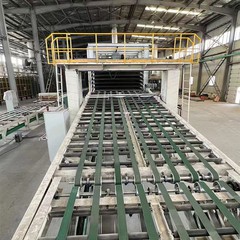
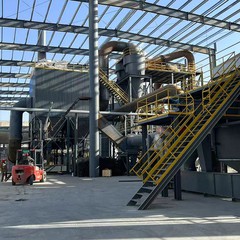
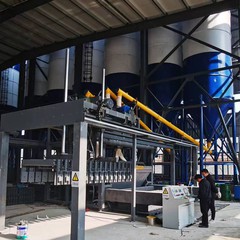
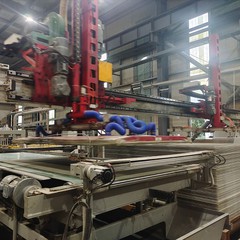





Shineye Mach Co., Ltd. is one of the leading manufacturers and suppliers of High-Strength Gypsum Board Production Line in China. If you're going to buy the newest High-Strength Gypsum Board Production Line made in China, welcome to get quotation from our factory. All customized products are with high quality and competitive price.
What Is a High-Strength Gypsum Board Production Line?
The line processes gypsum powder with reinforcing fibers and inorganic additives, forming boards 10–30 mm thick, 1220/1250 mm wide, and up to 3600 mm long. Annual capacity depends on configuration, board thickness, and shift schedule.


Key Specifications
| Item | Specification |
|---|---|
| Capacity | Depending on configuration |
| Thickness | 10–30 mm |
| Width | 1220 / 1250 mm |
| Length | Up to 3600 mm |
| Density | Depending on formulation |
| Compressive Strength | Design target, formulation-dependent |
| Bending Strength | Design target, formulation-dependent |
| Automation | Up to 100% |
| Control | SCADA + 15-inch HMI |
| Line Speed | 2–15 m/min |
Mechanical properties are formulation-dependent design targets and require third-party verification. No specific strength value should be assumed without material test data.
What Makes High-Strength Boards Different
High strength is not created by one machine. It is created by the interaction of five process controls:
| Process Control | What Changes vs. Standard Line |
|---|---|
| Reinforcing materials | Fibers and additives are pre-blended before the main mixer - not dosed into the gypsum stream directly. |
| Controlled density | Density is controlled during forming, with the target set by the formulation. |
| High-pressure forming | Hydraulic rollers compact the slurry at higher pressure, raising density and strength. |
| Precise additive dosing | Dosing accuracy depends on the specific feeder configuration. |
| Controlled drying | Multi-zone drying uses tighter temperature windows to protect fibers from heat degradation. |
If one variable drifts, the others cannot fully compensate. Uneven fiber distribution creates weak zones. Low density reduces strength. Insufficient forming pressure leaves voids. Overly aggressive drying degrades fibers. This line holds these variables within a repeatable window, so a formulation that passes lab testing can be reproduced in daily production.
How High Strength Is Achieved
Step 1 - Reinforcement
Fibers are distributed evenly through the slurry, creating internal reinforcement that resists cracking under load.
01
Step 2 - Controlled Formulation
Additives are dosed consistently. Small dosing errors can shift the final strength outside the target range.
02
Step 3 - Density Control
The board is compacted to a target density that depends on the formulation and target mechanical properties.
03
Step 4 - High-Pressure Forming
Hydraulic rollers compact the slurry under controlled pressure, creating a denser board structure with fewer voids.
04
Step 5 - Controlled Drying
Moisture is removed without unnecessarily degrading reinforcement materials.
05
What Happens During Commissioning
The recipe is not fixed at the factory. During commissioning, forming pressure, slurry moisture level, and dryer zone temperatures are adjusted according to the actual gypsum source and reinforcement materials on site.
If local gypsum has higher moisture content than the reference sample, dryer residence time is extended and the first zone temperature is lowered slightly to avoid surface cracking. Once the board reaches target density and passes the strength test, the final settings are recorded as the production recipe for that material combination.
This is why raw material testing before commissioning is part of our standard service.

Product Features
High-pressure forming unit - Hydraulic rollers apply controlled compaction force.
Fiber dosing system - A pre-blending station distributes fibers and additives through independent feeders.
Multi-zone dryer - The dryer has 3–5 independent zones and includes heat recovery.
SCADA control - The system provides real-time monitoring, parameter logging, and recipe storage.
Batch traceability - Every batch is logged with timestamps for additive ratios, temperatures, speeds, and pressures.
Flexible dimensions - Thickness 10–30 mm, width 1220/1250 mm, lengths up to 3600 mm.

Production Process
Gypsum Preparation → Fiber & Additive Pre-Blending → Precision Mixing → High-Pressure Forming → Cutting → Controlled Drying → Strength & Density Testing → Stacking & Packaging
| Stage | What Happens | Why It Matters for Strength |
|---|---|---|
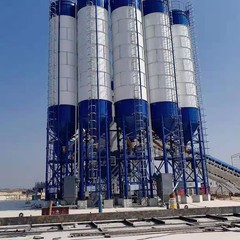
| 1. Gypsum Preparation | Gypsum powder stored in silos. | Raw material quality sets the upper limit for achievable strength. |
| 2. Fiber & Additive Pre-Blending | Fibers and additives pre-blended before the main mixer. | Prevents fiber clumping and ensures even distribution. |
| 3. Precision Mixing | Dual-shaft mixer with controlled dosing. | Consistent dosing keeps batch-to-batch strength consistent. |
| 4. High-Pressure Forming | Hydraulic rollers compact the slurry. | Compaction pressure drives density, and density drives strength. |
| 5. Cutting | Synchronized flying saw. | The saw ensures dimensional accuracy for installation. |
| 6. Controlled Drying | Multi-zone drying with heat recovery. | Removes moisture without degrading fibers. |
| 7. Strength & Density Testing | Thickness, density, compressive and bending strength - every batch. | Testing confirms the board meets its target before shipment. |
| 8. Stacking & Packaging | Automatic stacking with interleaving paper. | Stacking protects board edges and surfaces. |

Quality Control & Testing
Quality control follows a chain. Each step depends on the one before it:
| Control Point | Why It Matters | Typical Target |
|---|---|---|
| Board density | Density is the strongest single predictor of mechanical performance. | Depends on formulation; SCADA-logged per batch. |
| Additive dosing | Directly affects strength development and batch consistency. | Accuracy depends on feeder configuration; see Technical Configuration. |
| Drying profile | Drying parameters are logged per batch. | Multi-zone; temperature window depends on formulation. |
| Final strength testing | Confirms every batch meets its target before it leaves the line. | Compressive and bending test per batch. |
Every batch is tested for compressive strength, bending strength, and density. Full batch traceability is standard, so any deviation can be traced to a specific stage - usually dosing or drying - rather than requiring a full reformulation.
Boards from this line are suitable for testing to applicable product standards for gypsum board. Specific standard applicability depends on the target market and product formulation. "Can be tested to" is not the same as "certified to" - certification requires specific formulations, documented processes, and accredited lab testing of your actual product. Shineye provides the technical documentation; certification is issued by accredited bodies in your market.
For structural, fire-rated, or load-bearing applications, assembly-level testing and project-specific approval are required.
Applications
| Application | Typical Use |
|---|---|
| Exterior Cladding Systems | Non-load-bearing applications where the board is specified as part of a certified exterior wall or cladding system. |
| Industrial Enclosures | High-impact zones. Non-structural unless part of a certified system. |
| Shaft Walls | Elevator, service, stairwells - per local code and certified design. |
| Acoustic Wall Systems | Higher-density boards can contribute to sound-control assemblies when combined with appropriate system design. |
| Modular Panels | Prefabricated construction. Non-structural unless certified. |
| Fire-Rated Assemblies (Certified Systems Only) | Only as part of a complete wall assembly tested and certified to the applicable fire standard. |
Where the product system is specified for conventional gypsum-board installation, boards can be cut, fixed and finished using compatible installation methods. Higher density and fiber reinforcement give the board more resistance before cracking or deformation starts.


Technical Configuration
| Category | Parameter | Range |
|---|---|---|
| Line Dimensions | Length / Width / Height / Weight | 60–150 m / 8–15 m / 4–8 m / 80–250 tons |
| Power & Utilities | Installed Power | Depending on configuration |
| Voltage | 380/415/480V, 50/60 Hz | |
| Compressed Air | 0.6–0.8 MPa, 3–6 m³/min | |
| Water | 5–15 m³/hour | |
| Dryer Fuel | Natural gas / LPG / diesel / oil | |
| Thermal Energy | Depending on dryer configuration | |
| Raw Material System | Gypsum Silo | 50–200 tons |
| Additive Feeders | Depends on formulation requirements | |
| Pre-blend Station | 2 m³ | |
| Mixer | Dual-shaft, 3–8 min residence | |
| Forming Section | Method | Continuous extrusion + high-pressure rollers |
| Mold | Hardened steel, anti-wear coating | |
| Drying Section | Zones | Depends on dryer configuration |
| Temperature | Window depends on formulation | |
| Residence | 20–60 minutes | |
| Heat Recovery | Depending on dryer configuration | |
| Cutting & Stacking | Cutting Method | Synchronized flying saw |
| Accuracy | ±2.0 mm | |
| Stacking | Automatic with interleaving paper | |
| Operation | Shifts | 1–3 per day |
| Noise | ≤85 dB(A) | |
| Dust Emission | ≤10 mg/m³ | |
| Warranty & Standards | Standard Warranty | 12 months |
| Extended Warranty | Up to 24 months | |
| Testing Standards | Applicable product standards for gypsum board; specific applicability depends on target market and formulation |
Mechanical properties are design targets, verified by third-party testing. All parameters are configuration-dependent and should be confirmed against project specifications.
Buyer Checklist
| Category | Items to Confirm |
|---|---|
| Production | Target annual output; board dimensions; thickness range; target mechanical properties |
| Raw materials | Gypsum purity and consistency; reinforcing material availability; additive supply |
| Site & utilities | Voltage and frequency; dryer fuel; factory dimensions; water and compressed air |
| Market & compliance | Local certification requirements; intended applications; target market positioning |
What Buyers Usually Underestimate
In practice, raw material consistency is often more difficult to control than equipment capacity. Two gypsum sources with the same nominal specification can require different water, additive, and drying settings. Switching sources without re-testing will shift strength results.
Reinforcing fiber is not a commodity. Length distribution, surface treatment, and moisture content vary between suppliers. A formulation that works with one fiber batch may need adjustment for the next.
The dryer is the most underestimated section. A small change in zone temperature or residence time can shift board strength measurably. SCADA logging is what tells you whether a strength drop came from dosing, forming, or drying.
In humid climates, slurry moisture content changes with the season, and dryer settings need adjustment. Buyers in tropical or coastal regions need to account for seasonal recipe adjustments.
A high-strength line is more sensitive to operator decisions than a standard line. Training and ramp-up time are part of the production cost, not optional extras.
Engineering & After-Sales Services
| Phase | What We Provide |
|---|---|
| 01 - Pre-Sales Planning | Capacity, raw material and factory assessment. |
| 02 - Process & Engineering Design | Layout, utilities and equipment configuration. |
| 03 - Installation & Commissioning | Installation supervision, testing and operator training. |
| 04 - Production Optimization | Process adjustment, formulation trials and production ramp-up. |
| 05 - After-Sales Support | Remote support, spare parts and maintenance guidance. |
Certification support: technical documentation for applicable product standards. Assembly-level certification remains with accredited bodies. Warranty: 12 months standard, extendable to 24 months.
Why Choose Shineye
-
Engineering depth - R&D focuses on additive dosing and process control, the two areas that matter most for high-strength board production.
-
In-house manufacturing - Fabrication, CNC machining, assembly, and quality inspection under one roof.
-
Quality control - ISO 9001:2015 certified. Batch-level traceability built into every line.
-
International experience - Lines delivered in Central Asia, the Middle East, and Southeast Asia.
-
Full lifecycle support - From raw material assessment to production ramp-up and after-sales service.

Shineye Mach Co., Ltd. (Xiangyi Machinery) has been manufacturing gypsum board production equipment since it was founded in 2002. Factory address: Circular Economy Industrial Park, Dongzicheng Village North, Jinzhou City, Hebei Province, China - close to Tianjin and Qingdao ports.

Project Experience
Shineye has supplied high-strength gypsum board lines in Central Asia, the Middle East, and Southeast Asia. Each installation is configured around the customer's production targets, local raw material quality, board dimensions, target strength, and site conditions.
Project references are available upon request. Specific project details are shared under a signed confidentiality agreement.
Frequently Asked Questions
Q: 1. What is a high-strength gypsum board production line?
A: An industrial system designed to manufacture gypsum boards with higher mechanical strength than conventional panels, through reinforcement, controlled density, high-pressure forming, and precise process control.
Q: 2. What makes high-strength gypsum board different from standard board?
A: The difference comes from fiber reinforcement, controlled density, high-pressure forming, precise additive dosing, and controlled drying. A high-strength board is not automatically load-bearing.
Q: 3. What compressive and bending strength can the line target?
A: Design targets depend on formulation, raw materials, and production conditions, and require lab verification before use in a project specification.
Q: 4. Can local gypsum powder be used?
A: Possibly. We test your materials during commissioning to confirm compatibility. Many customers use local gypsum with our reinforcing material package.
Q: 5. Can the same line produce standard and high-strength boards?
A: Configured for high-strength grades and selected standard formulations. Recipe changeover depends on formulation and cleaning requirements.
Q: 6. What production capacity is available?
A: Capacity depends on board thickness, line speed, and shift schedule. Send us your target output and board specifications, and we can recommend a configuration.
Q: 7. What board sizes can the line produce?
A: Thickness 10–30 mm, width 1220/1250 mm, length up to 3600 mm.
Q: 8. Can high-strength gypsum board be used in fire-rated or structural systems?
A: Not by itself. A high-strength board is not a load-bearing product, and it does not establish a fire rating on its own. Structural use requires a certified assembly system, project-specific structural design, and approval by a qualified engineer under local building codes. Fire-rated use requires a complete wall assembly tested and certified to the applicable fire standard.
Q: 9. How does SCADA improve production consistency?
A: SCADA monitors and logs key parameters in real time. On a high-strength line, the margin between passing and failing a strength test is narrower. Batch-level records show where a shift happened - usually dosing or drying - so the fix can be targeted instead of re-testing the entire formulation.
Q: 10. What information is required for line design and quotation?
A: Target capacity, board dimensions, target strength, raw material properties, factory dimensions, and local utility conditions. See the Buyer Checklist for the full list.
Request a Quote
A High-Strength Gypsum Board Production Line is a long-term investment. We can help you size it, configure it, and plan commissioning.
| Contact | Details |
|---|---|
| Phone / WhatsApp | +86 18132648037 |
| xiangyijixielucia@yeah.net | |
| Factory Address | Circular Economy Industrial Park, Dongzicheng Village North, Jinzhou City, Hebei Province, China |
| Contact Person | Jessica Li |
| Response Time | Within 24 hours on business days |
| Additional Service | Gypsum sample testing available upon request |
