

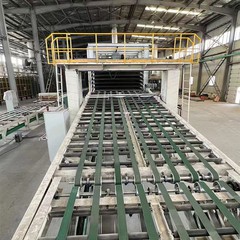
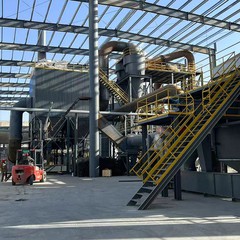
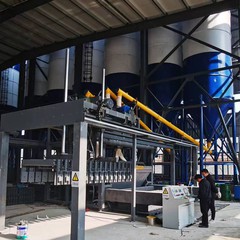
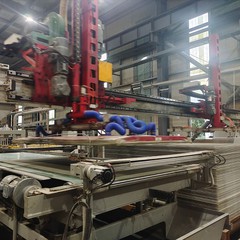





Shineye Mach Co., Ltd. is one of the leading manufacturers and suppliers of Fully Automatic Gypsum Board Production Line in China. If you're going to buy the newest Fully Automatic Gypsum Board Production Line made in China, welcome to get quotation from our factory. All customized products are with high quality and competitive price.
Fully Automatic Gypsum Board Production Line

Turnkey manufacturing solutions from 1.5 to 30 million m² per year. One supplier, one warranty, zero middlemen.
When you invest in a gypsum board plant, the sticker price of the equipment tells only a fraction of the story. The real drivers of long‑term profitability are thermal efficiency, labor structure, layout precision and maintenance costs - and those are engineered into the line long before the first board is formed. We manufacture, install and support every component ourselves. A Fully Automatic Gypsum Board Production Line takes raw gypsum powder, water and additives at one end, and delivers finished, paper‑faced boards - 7 to 15 mm thick, 1200 or 1220 mm wide - stacked and ready to ship at the other. One operator oversees the entire process from the central PLC console.
Key Highlights
-
Output: 1.5 – 30 million m² per year
-
Automation: Single‑operator PLC control
-
Drying: ≥85% thermal efficiency with six independent temperature zones
-
Labor: 10 – 15 operators per shift
-
Fuel flexibility: Natural gas, LPG, coal or fuel oil
-
Raw materials: Natural gypsum, FGD gypsum, phosphogypsum
-
Service life: 15 – 20 years with standard maintenance
-
Delivery: Turnkey - layout, equipment, shipment, installation, training

1. Match Capacity to Your Market
Choosing the right scale is your most important decision. Start with confirmed demand, not a five‑year projection.
Entering a new market
2 – 5 million m²/year
Expanding across regions
5 – 10 million m²/year
Export‑oriented or large‑scale supply
10 – 20 million m²/year
Multi‑country industrial group
20 – 30 million m²/year
A smaller line operating three shifts frequently outperforms a larger one running a single shift. When the market pulls harder, simply add a second gypsum board production line rather than over‑committing on day one. Board thickness also dictates annual output: 12 – 15 mm boards consume more dryer time than 7 – 9.5 mm boards, so a line dedicated to thin boards can deliver substantially more square meters.
2. What Really Drives Payback
Payback hinges on five operational realities, not on the equipment price tag.
| Gypsum powder cost | The single largest expense. Captive synthetic gypsum (e.g., from a power plant) slashes payback. |
| Fuel price | Drying consumes 60 – 70% of all energy. Every point of thermal efficiency flows directly to margin. |
| Shifts | Running three shifts triples the output from the same capital. |
| Confirmed orders | Pre‑sold capacity yields predictable returns; speculative supply takes longer. |
| Board selling price | A stronger local market compresses the payback period. |
Real example: A 5 million m² line in Pakistan returned its investment in 14 months. The customer had contracts signed and operated three shifts from startup. Under the opposite conditions - costly raw materials, high fuel, single shift - payback can extend to 3 – 4 years. Send us your local numbers (gypsum price, fuel cost, board price) and we will calculate a project‑specific ROI, not an industry average.
3. Site Preparation Checklist
Delayed site readiness is the number one cause of project overruns. Confirm these items before ordering.
1. Transformer: 100 – 800 kW. Upgrades can take weeks; verify early.
2. Voltage/frequency: 380 V / 50 Hz, customizable. Provide exact specs for pre‑shipment configuration.
3. Water: 5 – 10 m³/hour for slurry and cooling. Interruptions halt production.
4. Fuel: Pipeline connection or dedicated storage for your chosen energy source.
5. Workshop: 1,500 – 9,600 m². Building length is set by the dryer, not the forming section.
6. Finished‑goods storage: 800 – 1,500 m², covered and dry.
7. Raw material storage: 800 – 1,500 m². Paper rolls require humidity‑controlled conditions.
8. Foundation: Reinforced concrete per layout drawings. No estimates.
9. Environmental permits: Initiate early for dust, noise and wastewater compliance.
10. Transport access: Clear path for components up to 12 m long and 3.5 m high.
Use this checklist 30 days before equipment arrives. Share site photos with our engineers - we frequently catch constraints that are easy to miss locally. Shipment is never released until we jointly confirm site readiness.

4. Lock In Low Operating Costs
Day‑to‑day expenses decide profitability once the line is running.

Energy savings
Raising dryer efficiency from 80% to ≥85% saves USD 50,000 – 80,000 annually on a 5 million m² line. Over a 15‑year lifecycle, that's over half a million dollars back in your pocket.
Labor efficiency
Full automation nearly halves the required workforce compared to semi‑automatic setups, lowering salaries, training burden and turnover risk.
Maintenance strategy
Stainless steel forming plates serve 8 – 10 years; carbon steel lasts 2 – 3. Siemens PLC modules show measurably lower failure rates. Paying for durability upfront lowers total cost over time.
Fuel sovereignty
Choose the energy source that is cheapest and most reliable in your region. Burners can be swapped with minor adjustments if local economics change - coal where it's cheap, gas where it's subsidized. Don't outsource that decision.
5. Features That Earn Their Keep
| Feature | Upfront Impact | Payback | Verdict |
|---|---|---|---|
| Heat recovery system | + USD 90 – 150 k | 18 – 24 months | Essential - 8 – 12 % fuel savings |
| Stainless steel forming plate | Higher than carbon steel | 2 – 3 years | Essential - 8 – 10 year life vs. 2 – 3 |
| Siemens PLC | Moderate premium | Indirect | Essential - fewer failures, rapid diagnostics |
| On‑site spare parts kit | USD 5 – 15 k | Immediate | Essential - downtime costs more than parts |
| Central control room | Moderate | Indirect | Recommended - single‑operator visibility |
Adding manual intervention points to save capex is a short‑term play. Labor costs tend to rise, not fall. Most customers start fully automatic and never look back.
Full Technical Specifications
The table below covers every specification of a Fully Automatic Gypsum Board Production Line that impacts daily output and operating cost. No omissions.
| Parameter | Specification |
|---|---|
| Annual capacity | 1.5 – 30 million m² |
| Line speed | 0 – 30 m/min (dryer‑limited, adjustable) |
| Board thickness | 7 – 15 mm (stepless adjustment) |
| Board width | 1200 mm or 1220 mm |
| Board length | 1800 – 3600 mm (adjustable) |
| Board density | 600 – 800 kg/m³ |
| Quality standard | GB/T9775-2008 / ASTM C1396 |
| Raw gypsum fineness | ≥ 100 mesh |
| Facing paper | 170 – 180 gsm |
| Installed power | 100 – 800 kW (capacity‑dependent) |
| Power supply | 380 V / 50 Hz (customizable) |
| Water consumption | 5 – 10 m³/hour |
| Compressed air | 0.6 – 0.8 MPa |
| Dryer type | Multi‑zone roller / plate dryer, 6 independent temperature zones |
| Thermal efficiency | ≥ 85 % (with heat recovery) |
| Heat source | Natural gas, LPG, coal, fuel oil (swappable burner) |
| Fuel consumption (gas reference) | Approx. 30 – 35 m³ per ton of board (5 million m² line) |
| Temperature control | Layered & zoned automatic PID |
| Control system | Siemens PLC with HMI, single‑operator monitoring |
| Forming station | Stainless steel (optional upgrade from carbon steel) |
| Cutting accuracy | ± 1 mm |
| Thickness tolerance | ± 0.2 mm (laser sensors every 50 mm) |
| Workforce | 10 – 15 operators per shift |
| Floor area | 1,500 – 9,600 m² |
| Total line length | Approx. 80 – 300 m |
| Service life | 15 – 20 years with routine maintenance |
| Warranty | 12 months |
| Installation | 4 – 8 weeks + 2 – 4 weeks commissioning |
| Noise level | ≤ 85 dB(A) |
| Dust control | Bag filter system, environmental compliant |
Production Process
1. Raw material feeding - Gypsum powder (≥100 mesh) and facing paper (170 – 180 gsm) enter the line.
2.Batching & mixing - Powder, water and additives are automatically metered and blended.
3.Board forming - Slurry is continuously deposited between top and bottom paper facings; thickness adjusts on the fly.
4.Paper facing - Both surfaces are faced while the core is wet, ensuring a permanent bond.
5.Setting & cutting - The board hardens on a setting belt and is cut to the ordered length.
6.Drying - A multi‑stage kiln applies independent layer and zone temperature control.
7.Edge trimming & inspection - Edges are trimmed to width; thickness and surface are checked automatically.
8.Stacking & packaging - Finished boards are stacked and wrapped, ready for dispatch.
Why Manufacturers Choose Our Line
We build it
Every major component is fabricated in our own facility. When you call with a question, you speak to the people who made the machine - not a trading intermediary.
01
We install it.
Our own engineering team handles erection and commissioning. No subcontractors, no finger‑pointing. A typical 5 million m² line is installed in 4 – 8 weeks.
02
We keep parts ready.
Motors, bearings, sensors, PLC modules - we hold a comprehensive spare‑parts inventory. Customers who contact us years after installation almost always find what they need on the shelf.
03
We stay until you run.
Training continues on your site until your operators independently control the line - adjusting thickness, changing recipes, performing routine maintenance and troubleshooting.
04
We design around your reality.
Before drawing the first layout we evaluate your power quality, gypsum sample, ambient climate, actual fuel availability, floor constraints and operator skill level. The line is built for your site, not the other way around.
05


Track Record
2010 - Inner Mongolia, 10 million m²/year
2023 - Pakistan, 5 million m²/year
2025 - Pakistan, 6 million m²/year
2026 - Southeast Asia, 5 million m²/year
Frequently Asked Questions
Q: What is a fully automatic gypsum board line?
A: A continuous, PLC‑controlled system that converts gypsum powder, water and additives into paper‑faced boards, ready for shipment.
Q: How many operators are needed?
A: 10 – 15 per shift. The PLC handles real‑time adjustments that manual lines require multiple workers to manage.
Q: How does automation improve quality?
A: Thickness, density, temperature and line speed are monitored continuously. Laser sensors placed every 50 mm hold thickness tolerance to ±0.2 mm.
Q: Which fuel can I use?
A: Coal, fuel oil, natural gas or LPG. Burners can be exchanged with minimal modifications if your economics change.
Q: How long does installation take?
A: 4 – 8 weeks of mechanical installation, plus 2 – 4 weeks for commissioning and operator training.
Q: Which standard do the boards meet?
A: GB/T9775-2008, which aligns with ASTM C1396 for export markets.
Q: Is this a true turnkey solution?
A: Yes. Layout, manufacturing, shipping, installation, commissioning, training and ongoing support - all under one warranty and one point of contact.
Start With a Customized Proposal
Tell us your target capacity, raw material source, preferred fuel and planned shift schedule. Within 48 hours we will deliver a preliminary layout drawing and a project‑specific ROI calculation for your Fully Automatic Gypsum Board Production Line.
Our address
North of Dongzicheng Village, Circular Economy Industrial Zone, Jinzhou City, Hebei Province, China
Phone Number
+86 18132648037
xiangyijixielucia@yeah.net
Contact: Jessica Li
