

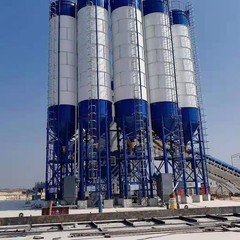





Shineye Mach Co., Ltd. is one of the leading manufacturers and suppliers of Waterproof Gypsum Board Production Line in China. If you're going to buy the newest Waterproof Gypsum Board Production Line made in China, welcome to get quotation from our factory. All customized products are with high quality and competitive price.
Waterproof Gypsum Board Production Line Overview
A Waterproof Gypsum Board Production Line is an integrated system that produces gypsum boards with controlled water absorption. The equipment handles the entire process from raw material storage to finished panel stacking in one continuous production flow.
Depending on the formulation, the line can produce boards with different water absorption targets. The standard configuration targets ≤5% over 24 hours. For more demanding applications, the formulation can be adjusted to achieve ≤3% or ≤2% absorption.
The standard configuration delivers 50,000–250,000 m² per year. Expanded configurations, with additional modules, can increase output to 400,000 m²/year.
Actual capacity varies with board thickness, target water absorption, raw material quality, local power supply, and available factory space. Shineye works with customers to determine the appropriate line configuration for each project.

Key Production Data - What Buyers Check First
| Item | Specification |
|---|---|
| Annual Capacity (Standard) | 50,000 – 250,000 m²/year |
| Annual Capacity (Expanded) | Up to 400,000 m²/year |
| Target Water Absorption | ≤5% (24 hours) |
| Board Thickness Range | 8 – 25 mm |
| Board Width | 1220 / 1250 mm |
| Board Length | 1800 – 3600 mm |
| Line Speed | 2 – 12 m/min |
| Automation Level | 80 – 100% |
| Drying Zones | 3 – 5 zones, 80 – 210°C |
| Design Service Life | ≥15 years |
Power & Utilities
| Item | Specification |
|---|---|
| Installed Power | 80 – 200 kW |
| Voltage | Customizable: 380/415/480V, 50/60 Hz |
| Compressed Air | 0.6 – 0.8 MPa, 3 – 6 m³/min |
| Water | 5 – 15 m³/hour (closed-loop optional) |
| Dryer Fuel | Natural gas / LPG / diesel / oil |
| Thermal Energy | 700,000 – 2,200,000 kcal/hour |
For complete technical specifications, see the full parameter table below.

Waterproof Gypsum Board Production Process Flow
Gypsum Storage → Additive Dosing → Pre-Blending → Continuous Mixing → Board Forming → Precision Cutting → Multi-Zone Drying → Quality Inspection → Automatic Stacking


Raw Material Preparation & Pre-Blending
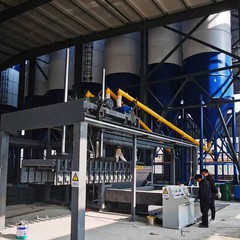
Gypsum powder is stored in silos with 50 to 200 tons capacity, depending on configuration. Moisture-resistant additives - hydrophobic fibers, water-repellent agents, flow modifiers - pass through a dedicated dry pre-blending station before entering the main mixer.
Operational benefit: Two-stage mixing improves additive distribution uniformity and reduces batch-to-batch variation. This translates to more reliable recipe switching across different water absorption grades and lower scrap rates.
Continuous Mixing
Pre-blended dry materials are pneumatically conveyed to the main dual-shaft mixer, where they combine with gypsum and water. Dosing accuracy is ±1%. Residence time ranges from 3 to 8 minutes.
Effect on production: Dosing accuracy directly correlates with water absorption test results. Consistent dosing (±1%) maintains batch-to-batch uniformity and minimizes rejection risk during customer quality acceptance.
Board Forming
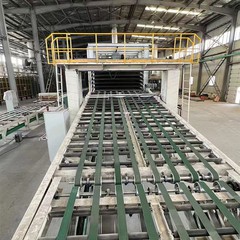
The slurry flows continuously onto the forming line. Roller calibration and high-precision molds maintain thickness at ±0.1 mm. Automated thickness gauges monitor the process and provide real-time adjustments.
Implication for quality: Thickness deviation affects water absorption test outcomes. ±0.1 mm precision ensures absorption data remains stable across batches, reducing the need for repeat testing and minimizing customer complaints.
Precision Cutting
A synchronized flying saw cuts the continuous board to programmed lengths. Accuracy: ±2.0 mm.
Operational impact: Consistent board dimensions eliminate on-site trimming during installation, reducing construction waste and labor costs at the job site.
Multi-Zone Drying
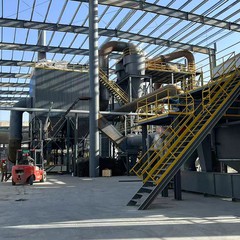
Panels pass through 3 to 5 independently controlled zones with hot air circulation at 80 to 210°C. Residence time ranges from 20 to 60 minutes. A heat recovery system captures waste energy, reducing consumption by up to 20%.
Key benefit: Multi-zone independent temperature control prevents overheating and uneven drying, preserving the effectiveness of moisture-resistant additives. Lower energy consumption directly reduces production costs per square meter.
Quality Inspection & Stacking
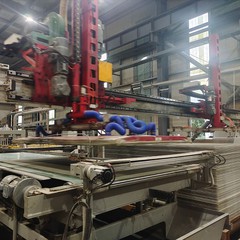
Every batch is checked for thickness, density, appearance, and 24-hour water absorption. The SCADA system logs all production parameters with timestamps. Finished boards are automatically stacked with interleaving paper between layers.
Traceability value: Full batch traceability enables root cause analysis if a customer reports abnormal water absorption. The system links each batch to specific production parameters and raw material deliveries, supporting systematic problem resolution.
What Determines Final Water Absorption?
Achieving ≤5% water absorption is not automatic - it depends on a combination of six factors working together. The following elements determine final moisture-resistant performance.
1. Formulation Design
Different water absorption targets require different formulations. The difference between standard ≤5% moisture-resistant boards and high-performance ≤3% or ≤2% boards lies primarily in the type and dosage of hydrophobic fibers and water-repellent additives. The line provides ±1% precision dosing for batch-to-batch consistency, but formulation confirmation requires raw material testing and collaboration between the customer and Shineye.
2. Board Thickness
Thickness directly affects water absorption test results. For the same formulation, thicker boards typically perform better in 24-hour water absorption tests due to the longer moisture penetration path. Absorption rates for 9mm and 25mm boards can differ significantly. Thickness selection must be based on target market requirements and end-use applications. The equipment provides thickness control precision (±0.1 mm), but the relationship between thickness and absorption is determined by product design.
3. Board Density
Higher density means fewer internal pores and fewer paths for moisture to enter. Board density typically ranges from 750 to 1150 kg/m³, adjusted through formulation and forming pressure. Higher density generally improves moisture resistance but may affect production speed and cost. The equipment provides the means to adjust density; specific targets must be determined based on product positioning.
4. Drying Profile
The multi-zone drying section maintains strict temperature control (80–210°C) to preserve additive effectiveness. Overheating or uneven drying can damage hydrophobic fibers and water-repellent additives. The drying profile must be correctly set for each formulation and board thickness to ensure consistent moisture-resistant performance across batches.
5. Production Traceability
The SCADA system records every production parameter with timestamps (see Quality Control & Testing for details). This enables systematic problem resolution when issues occur - distinguishing between formulation, raw material, or process-related causes.
6. Laboratory Testing
The equipment provides production capability, not product certification. Boards can be tested according to GB/T 9775, ASTM C1396, or EN 520 standards - but test capability is not equivalent to certification. Achieving certified ratings requires specific formulations, documented production processes, and accredited lab testing using the customer's actual product and assembly. Independent lab testing after equipment delivery confirms whether the product meets target market standards.
Core Equipment & Control Systems
When evaluating equipment, buyers assess whether the line can consistently produce boards meeting ≤5% water absorption targets. The following equipment is organized by production flow, with each stage corresponding to a specific procurement consideration.
Raw Material Handling System - Additive Uniform Dispersion
Gypsum silos with 50 to 200 tons capacity provide raw material buffer for continuous production. The additive dosing system includes 2 to 6 high-precision feeders with ±1% metering accuracy.
Evaluation point: Additive distribution uniformity directly affects batch pass/fail rates. The pre-blending station design influences additive dispersion in the main mixer - two-stage mixing provides more reliable distribution than single-stage.
Formulation System - Recipe Changeover Efficiency
The dual-shaft mixer is the core of the formulation system, with 3 to 8 minutes residence time.
Evaluation point: Formulation differences between ≤5% and ≤3% water absorption boards can be significant. Mixer cleaning and changeover time directly affects production efficiency and scrap rates. Extended changeover times increase the cost of small-batch orders.
Board Forming System - Thickness Precision
The forming section uses continuous extrusion with roller calibration, holding thickness tolerance to ±0.1 mm.
Evaluation point: Thickness deviation directly affects 24-hour water absorption test results. Boards exceeding thickness tolerance may fail testing even with correct formulation. Automatic thickness gauge response speed determines scrap rate - faster deviation detection reduces material waste.
Thermal Processing System - Drying Profile Accuracy
The multi-zone dryer has 3 to 5 independently controlled zones with temperature range of 80 to 210°C.
Evaluation point: Hydrophobic fibers and water-repellent additives can fail at elevated temperatures. Improper drying profiles can compromise final water absorption results even with correct formulation and forming precision. Multi-zone control allows temperature settings at each stage to accommodate different board thicknesses.
Finishing System - Cutting Precision
The flying saw cuts the continuous board to programmed lengths with ±2.0 mm accuracy, with programmable length range of 1800 to 3600 mm.
Evaluation point: Cutting precision affects on-site installation efficiency. Excessive length deviation requires on-site trimming, increasing labor costs. Programmable length capability allows multiple specifications from one machine without adjustments.
Automation & Data System - Production Traceability
The SCADA control system includes a 15-inch HMI, stores 100+ recipes, and records all production parameters with timestamps.
Evaluation point: When boards fail water absorption testing, SCADA data identifies whether the issue was dosing deviation, drying temperature fluctuation, or raw material batch. Equipment without data traceability requires troubleshooting without systematic data support.
Complete Equipment Configuration Table
| Equipment | Function | Key Specifications |
|---|---|---|
| Gypsum Silo | Raw material storage | 50–200 tons |
| Additive Dosing System | Precision moisture-resistant additive metering | 2–6 feeders, ±1% accuracy |
| Pre-Blending Station | Dry additive mixing | 2 m³ capacity |
| Dual-Shaft Mixer | Continuous slurry mixing | 3–8 min residence |
| Forming Station | Board forming and thickness control | ±0.1 mm tolerance |
| Flying Saw | Synchronized length cutting | ±2.0 mm accuracy |
| Multi-Zone Dryer | Moisture removal | 3–5 zones, 80–210°C |
| Stacking System | Automatic stacking | Up to 1.5 m height |
| SCADA Control System | Process monitoring and control | 15" HMI, 100+ recipes |
Optional extras:
Automatic pallet changer
Remote diagnostics module
Dew point control for humid climates
Enhanced corrosion protection
Extended warranty (up to 24 months)

Board Applications & Procurement Scenarios
Typical Application Areas
| Application Area | Typical Use |
|---|---|
| Bathrooms & Toilets | Wall panels, ceiling systems, shower enclosures |
| Kitchens | Backsplashes, wall panels, sink surrounds |
| Basements | Wall linings, partitions |
| Humid Interior Spaces | Laundry rooms, utility areas |
| Commercial Buildings | Office restrooms, food service areas |
| Industrial Facilities | High-humidity process areas |
| Moisture-Prone Areas | Other interior spaces where humidity control is a design consideration |
The boards install using standard gypsum board methods - cutting, screwing, and finishing. No special tools or additional training are required. In coastal regions and high-rainfall areas, these boards are increasingly specified as standard practice.


Which Procurement Scenarios Does This Fit?
| Procurement Scenario | Applicable Customers | Typical Needs |
|---|---|---|
| New Gypsum Board Plant | Investors building new production facilities | Localized production, import substitution, reduced logistics costs |
| Existing Manufacturer Expansion | Gypsum board producers with existing lines | Product line expansion, adding moisture-resistant boards, co-production with standard boards |
| Regional Building Material Supplier | Material suppliers serving local construction markets | Meeting local code requirements, shorter lead times, ability to take on large orders |
Specialized applications may include exterior wall systems or pool and sauna environments, subject to the selected board formulation, assembly design, and applicable testing requirements. These applications should be evaluated on a case-by-case basis with appropriate product testing and certification.
Quality Control & Certification Support
Each batch is inspected for thickness, density, appearance, and 24-hour water absorption. The SCADA system records every production parameter with timestamps, ensuring full traceability from raw materials to finished boards.
The equipment can be configured to support production for products tested according to GB/T 9775 (China), ASTM C1396 (US), or EN 520 (Europe).
Raw material verification. Consistent raw material quality is essential - gypsum powder purity, additive consistency, and water quality all affect final product performance. The final formulation is adjusted based on the customer's local gypsum quality and the target water absorption level. This is determined during the raw material testing phase. Shineye tests local raw materials during commissioning and provides ongoing formulation guidance as material sources change.
Batch traceability. The SCADA system records every batch's production parameters - additive ratios, temperatures, speeds, pressures - with timestamps. This allows traceability of any product issue back to a specific production run.
Applicable testing standards. Different markets have different requirements. In China, the relevant standard is GB/T 9775. In the US, it's ASTM C1396. In Europe, it's EN 520.
Important: The line is designed to produce boards that can be tested to these standards. But "can be tested to" is not the same as "certified to." Achieving certified ratings requires specific formulations, documented production processes, and accredited lab testing. Shineye can assist with technical documentation to support certification applications.

Why Choose Shineye?
| Aspect | Details |
|---|---|
| Company | Shineye Mach Co., Ltd. (Xiangyi Machinery) |
| Founded | 2002 |
| Facility | 25,000 m² production base, 100+ employees, 50+ processing equipment sets |
| Certification | ISO 9001:2015 |
| Markets Served | 60+ countries |
| Service | 12-month warranty, 24/7 technical support, installation & training, spare parts supply |
| Documentation Support | Technical documentation for GB, ASTM, EN testing and certification applications |
Shineye is the English brand name; Xiangyi is the Chinese company name for the same entity.
Factory address: Circular Economy Industrial Park, Dongzicheng Village North, Jinzhou City, Hebei Province, China - close to Tianjin and Qingdao ports.

Engineering & Support Services
| Service Phase | What We Provide |
|---|---|
| Production Planning | Capacity calculation, product specification analysis, and factory layout planning |
| Raw Material Testing | Evaluation of local gypsum powder and additives to confirm formulation compatibility |
| Line Design | Equipment configuration based on capacity, board dimensions, and target water absorption |
| Installation & Commissioning | On-site installation supervision, equipment testing, and production commissioning |
| Operator Training | Training covering production operation, equipment maintenance, and quality control |
| After-Sales Support | Remote diagnostics, spare parts supply, and ongoing technical guidance |
Installation Projects
Over the years, Shineye has delivered gypsum board production systems for a range of international markets. Each installation is sized according to the customer's production targets, operating shifts, board dimensions, formulation requirements, and plant layout.
| Country | Project Scope |
|---|---|
| Indonesia | High-humidity climate adaptation |
| Uzbekistan | Local gypsum formulation support |
| India | Large-scale production system |
| Ukraine | Production line integration |
| Bangladesh | Corrosion protection for coastal environment |
| Belarus | Full automation for cold climate |
| Pakistan | Long-running installation |
| Kuwait | High-temperature climate adaptation |
Project data for reference only. Actual results vary based on site conditions, raw materials, and operational practices. Project capacity varies according to line configuration, number of production shifts, product specifications, and plant expansion.

Factory & Manufacturing Process
Shineye follows a structured quality approach in manufacturing its own production lines:
Material verification - All incoming steel and components are inspected.
CNC machining - Critical parts are produced to exact tolerances.
Sub-assembly - Major sections are assembled and tested in-house.
Control integration - SCADA systems are configured and calibrated.
Factory acceptance testing - Full dry-run simulation before shipping.
Packing and shipping - Corrosion-protected modules for international freight.
This ensures each line arrives ready for installation and commissioning at the customer's site.
For company facilities, certifications, and global experience, see Why Choose Shineye.

Frequently Asked Questions
Q: 1. Can this line produce different water absorption grades? How long does changeover take?
A: Water absorption is controlled by the additive recipe. The SCADA system stores multiple formulations - switching between ≤5%, ≤3%, or ≤2% absorption targets requires recalling a preset recipe. Changeover takes approximately 30–60 minutes. This flexibility allows the line to serve different market segments without requiring separate production equipment.
Q: 2. How is the annual capacity calculated? How should actual output be estimated?
A: Standard capacity of 50,000–250,000 m²/year is based on 12mm thickness, single-shift operation (8 hours), 300 working days per year, and 85% utilization. Double shifts or different thicknesses will change actual output. The sales team can provide capacity estimates based on specific production parameters.
Q: 3. How many operators are needed?
A: With 80–100% automation, typically 1–2 operators per shift are required for production monitoring. Maintenance and quality control personnel are additional and do not need to be on-site full-time.
Q: 4. What does the quotation include? What information is needed to prepare one?
A: Quotation preparation requires target annual capacity, board dimensions, target water absorption, operating shifts, local voltage and fuel availability, factory space, and target market. The quotation typically covers the main equipment, SCADA system, auxiliary equipment (silos, feeders, dryer, stacker), installation support, commissioning, operator training, and a spare parts kit. Shipping, civil works, and site preparation are generally not included unless specified.
Q: 5. Does the equipment support different power standards and climate conditions?
A: Electrical systems are customized to local voltage and frequency (380/415/480V, 50/60 Hz). High-humidity environments can be equipped with enhanced corrosion protection; high-temperature environments can have drying system parameters adjusted. Shineye has project experience in 60+ countries.
Q: 6. How long does installation take? Is training provided?
A: On-site installation and commissioning typically takes 5–10 days, depending on site preparation and configuration complexity. Training covers operation, maintenance, quality control, and troubleshooting - typically for 2–3 operators. Installation and training are both included in the service scope.
Q: 7. Is it possible to use locally available gypsum powder to produce moisture-resistant boards?
A: Testing is required first. Shineye tests raw materials during commissioning to confirm formulation compatibility. Many customers use local gypsum powder with the additive package. Key factors are gypsum powder purity, additive consistency, and water quality. Formulation recommendations are provided based on raw material quality and target water absorption.
Q: 8. Does this line produce both standard and moisture-resistant boards?
A: Both. Switching formulations and adjusting additive dosing allows the same equipment to produce standard boards when moisture resistance is not required. Changeover takes approximately 30–60 minutes, enabling response to market demand without separate production lines.
Q: 9. What's the typical payback period?
A: Payback depends on equipment cost, local moisture-resistant board market prices, raw material costs, capacity utilization, and financing terms. The sales team can provide a financial analysis reference for specific target markets.
Q: 10. Can the equipment be customized based on specific production requirements?
A: The line uses a modular design. Standard capacity is 50,000–250,000 m²/year, which can be increased to 400,000 m²/year with additional shifts, expanded drying zones, or automation modules. Equipment configuration can be customized based on capacity targets, product specifications, and site conditions.
Market Considerations
Demand for moisture-resistant gypsum boards is driven largely by regional building codes, climate conditions, and construction practices. In coastal areas and high-rainfall regions, these boards are increasingly specified as standard practice for bathrooms, kitchens, basements, and other wet areas.
Board pricing varies across markets. In some regions, moisture-resistant boards command a premium over standard boards due to the additives and tighter process control required. The actual margin depends on additive costs, local selling prices, certification requirements, and production utilization. Manufacturers producing locally can reduce logistics costs and lead times, which are factors in overall project economics.
Production planning should account for board dimensions, line speed, and shift schedules. The line can be configured for specific board thickness, target water absorption, and local raw material quality. Factory space requirements depend on the selected capacity and equipment configuration - Shineye provides preliminary layout planning based on available site dimensions and production targets.

Request a Quote
Investing in a Waterproof Gypsum Board Production Line puts you in a growing segment of the construction materials market - the part where moisture control drives demand. Shineye provides engineering depth, manufacturing capacity, and a global service network. From initial consultation through long-term after-sales support, we're there.
For detailed quotations, technical discussions, or a virtual factory tour, contact the sales engineering team.
| Contact Method | Details |
|---|---|
| Phone / WhatsApp | +86 18132648037 |
| xiangyijixielucia@yeah.net | |
| Factory Address | Circular Economy Industrial Park, Dongzicheng Village North, Jinzhou City, Hebei Province, China |
| Contact Person | Jessica Li |
| Response Time | Within 24 hours on business days |
| Additional Service | Gypsum sample testing available upon request |
