

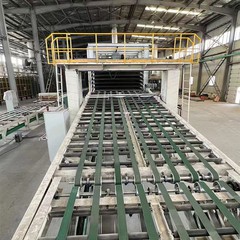
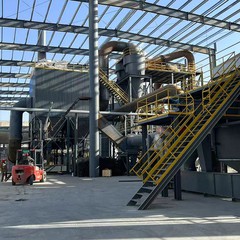
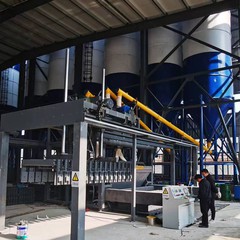
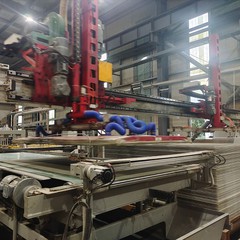
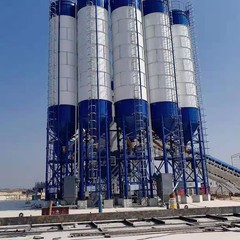





Shineye Mach Co., Ltd. is one of the leading manufacturers and suppliers of Automatic Gypsum Board Production Line in China. If you're going to buy the newest Automatic Gypsum Board Production Line made in China, welcome to get quotation from our factory. All customized products are with high quality and competitive price.
This production line is a continuous thermochemical processing system that transforms calcined gypsum powder, water, and additives into finished paper-faced panels through an integrated sequence of material handling, slurry forming, thermal drying, and automated finishing operations. Understanding its engineering fundamentals supports plant designers, project managers, and technical decision-makers in capacity planning and equipment selection.
Gypsum board manufacturing combines hydration reaction kinetics, thermal mass transfer, and precision mechanical handling. The core engineering challenge lies in balancing competing constraints:

01
Reaction rate vs. production speed
02
Drying temperature vs. board integrity
03
Energy input vs. product stability
04
Capital investment vs. per-unit operating cost
For any gypsum board production line, these trade-offs determine both the initial equipment specification and the long-term operating economics. This guide addresses each systematically, providing engineering frameworks for equipment selection, capacity planning, and operational optimization for an Automatic Gypsum Board Production Line.
System Architecture Overview
The line operates as a synchronized sequence of unit operations, each with defined input-output relationships. The overall system can be modeled as a series of interconnected transfer functions, where the output of each stage becomes the input for the next.
1. Mass Balance
For a typical 15 million m²/year line producing 12.5mm standard boards:
|
Material |
Input (tons/day) |
Output (tons/day) |
|
Calcined gypsum powder |
380-420 |
- |
|
Water (total) |
260-290 |
- |
|
Facing paper |
25-30 |
- |
|
Additives |
2-5 |
- |
|
Finished boards |
- |
480-520 |
|
The drying stage removes approximately 140-180 tons of water per day, representing the largest energy demand in the system. |
2.Throughput Bottleneck
In most gypsum board production line configurations, the dryer is the throughput constraint. The forming section can typically operate 15-20% faster than the dryer can process, making dryer capacity the effective production ceiling. When specifying a line, sizing the dryer for the target peak output plus 15% buffer is a recommended practice.

Forming Section Engineering
1. Thickness Control
Board thickness is determined by the gap between the upper and lower forming rollers, the slurry flow rate, and the conveyor speed. The relationship is nonlinear due to slurry expansion during setting and shrinkage during drying.
Closed-loop control logic:
1. Laser sensors measure thickness at 50mm intervals across the board width
2. Data is filtered through a moving-average algorithm to reject noise
3. PLC compares filtered value to setpoint and calculates error signal
4. Hydraulic actuators adjust roller gap via PID control
5. Feed-forward compensation adjusts slurry flow rate for speed changes
6. The system achieves steady-state thickness tolerance of ±0.2mm for 12.5mm boards, with settling time under 3 seconds.

2. Edge Formation
The edge-folding system uses a series of progressively angled folding rollers that crease the paper facing around the gypsum core. Key parameters:
1. Fold angle progression: 15° → 30° → 45° → 90°
2. Folding roller pressure: 50-200 N, controlled by pneumatic cylinders
3. Minimum edge paper overlap: 8mm
4. The system includes visual monitoring of the fold profile with automatic alarm if geometry deviates from set parameters.

Drying System Design
1. Drying Curve
The drying process follows a characteristic moisture removal curve with three distinct phases:
|
Phase |
Moisture Content |
Rate-Limiting Factor |
Duration |
|
Constant Rate |
18% → 12% |
Surface evaporation |
15-25 min |
|
Falling Rate |
12% → 4% |
Internal diffusion |
20-35 min |
|
Equalization |
4% → 1.5-2% |
Air equilibrium |
10-20 min |
The PLC adjusts zone temperatures to optimize progression through these phases. A properly configured Automatic Gypsum Board Production Line maintains zone temperatures as follows:
|
Zone |
Temperature |
Function |
|
1 |
160-170°C |
Initial heating |
|
2 |
180-200°C |
Constant-rate drying |
|
3 |
200-215°C |
Peak drying |
|
4 |
200-215°C |
Sustained high-temperature |
|
5 |
180-190°C |
Transition |
|
6 |
150-160°C |
Final equalization |
2. Heat Recovery
The heat recovery system uses a gas-to-gas plate heat exchanger:
|
Exhaust inlet: 80-100°C |
|
|
|
Exhaust outlet after recovery: 55-65°C |
|
|
|
Combustion air preheat: 45-55°C above ambient |
|
|
|
Fuel reduction: 8-12% |
|
|
|
Exchanger material: 316L stainless steel |
|
|
Payback calculation:
Annual fuel savings = Annual consumption × Recovery efficiency × Unit cost
For a typical line consuming 4,000-6,000 tons of coal equivalent annually, savings range from $60,000-$120,000/year. With system cost of $90,000-$150,000, payback is 18-24 months.
3. Dryer Sizing Formula
Dryer capacity is determined by moisture removal rate and residence time:
Required heat input (kW) = Water removal (kg/hr) × 2,260 kJ/kg ÷ Thermal efficiency
For a 15 million m²/year line producing 12.5mm boards, water removal is 5,500-6,500 kg/hr. At 75% efficiency, required heat input is 16,500-19,500 kW.
Automation Control
1. Control Hierarchy
The automation system follows a three-level hierarchy:
|
Level |
Function |
Components |
|
Field |
Sensing and actuation |
Sensors, transducers, drives |
|
Control |
Real-time regulation |
PLCs, PID controllers, interlocks |
|
Supervision |
Process management |
HMI, data historians, remote access |
2. Sensor Network
he line incorporates 120-180 sensors, depending on configuration:
1. Slurry density: Coriolis flow meter
2. Thickness: 4-6 laser sensors across width
3. Weight: In-line scale at cutting station
4. Moisture: Microwave sensor at dryer outlet
5. Temperature: 18-24 thermocouples across zones
6. Airflow: Differential pressure sensors
7. Speed: Encoders on all driven rollers

3.Recipe Management
Each recipe contains 40-60 parameters:
|
Group |
Example Parameters |
Count |
|
Raw material ratios |
Gypsum/water, additives |
8-12 |
|
Mixing |
Speed, residence time |
4-6 |
|
Forming |
Roller gap, pressure, tension |
8-10 |
|
Conveyor |
Speed profile |
6-8 |
|
Drying |
Zone temperatures, airflow |
12-18 |
|
Cutting |
Length, trim width |
3-4 |
|
Quality |
Tolerance ranges |
10-15 |
Changeover executes a pre-programmed sequence transitioning all parameters gradually to avoid defects.
Quality Control
1. Inspection Specifications
|
Point |
Technology |
Resolution |
Reject Criteria |
|
Thickness |
Laser triangulation |
±0.05mm |
> ±0.25mm deviation |
|
Weight |
Load cell |
±10g |
> ±3% deviation |
|
Edges |
Line-scan vision |
0.2mm pixels |
Exposed core, tears |
|
Surface |
Multi-angle cameras |
0.1mm defects |
Scratches, wrinkles |
|
Moisture |
Microwave |
±0.1% |
<1.0% or >3.5% |
|
|
2 Statistical Process Control
The system automatically generates control charts for key parameters. When non-random variation is detected (e.g., 7 consecutive points above the mean), operators are alerted to investigate root causes. This practice typically reduces out-of-spec production by 60-70% compared to end-of-line inspection only.
Technical Specifications
|
Parameter |
Range |
Note |
|
|
Annual capacity |
5-30+ million m² |
300 days, 24-hour operation |
|
|
Line speed |
25-60 m/min |
Varies with board thickness |
|
|
Thickness range |
6-25 mm |
Up to 30mm available |
|
|
Thickness tolerance |
±0.2mm (≤15mm); ±0.3mm (>15mm) |
Laser closed-loop |
|
|
Width options |
900/1200/1220 mm |
Custom up to 1500mm |
|
|
Length range |
1800-3600 mm |
Adjustable |
|
|
Drying temperature |
160-220°C |
PLC zone control |
|
|
Drying cycle |
40-80 min |
Thickness dependent |
|
|
Installed power |
600-1500 kW |
Capacity dependent |
|
|
Fuel options |
Natural gas, LPG, diesel, oil, coal, biomass |
Customized |
|
|
Electrical supply |
380V/400V/440V, 50/60Hz, 3-phase |
Transformer available |
|
|
Service life |
15-20 years |
With maintenance program |
|
Capacity Planning
1 Selection Matrix
|
Factor |
5-10M m²/yr |
10-20M m²/yr |
20-30M m²/yr |
|
Investment |
Lower |
Medium |
Higher |
|
Per-unit cost |
Higher |
Competitive |
Lowest |
|
Market radius |
Regional |
Multi-region |
National/export |
|
Shifts |
1-2 |
2-3 |
3 |
|
Dryer zones/layers |
4-6 zones, 2-3 layers |
6-8 zones, 3-4 layers |
8-10 zones, 4-5 layers |
|
Floor space |
3,000-5,000 m² |
5,000-8,000 m² |
8,000-12,000 m² |
2. Common Sizing Considerations
|
Consideration |
Potential Impact |
Recommended Approach |
|
Dryer capacity |
May limit actual output |
Size for peak target +15% buffer |
|
Forming section speed |
May exceed dryer capacity |
Match to dryer capability |
|
Raw material storage |
Production may halt during disruptions |
Plan for 7-14 days storage |
|
Finished goods storage |
Stacking area may become a constraint |
Plan for 3-5 days production |
|
Utility connections |
Power or gas supply may limit operation |
Verify capacity before finalizing |
Performance Benchmarks
The following benchmarks are drawn from field data across multiple gypsum board production line installations. Individual results vary with board specifications, energy costs, and operating practices.
|
Metric |
Industry Typical |
This Line (Documented Range) |
|
Line availability |
85-88% |
92-95% |
|
Board waste rate |
3-5% |
0.8-1.5% |
|
Thickness deviation (standard deviation) |
±0.35mm |
±0.12mm |
|
Energy cost per m² (12.5mm board) |
Baseline |
15-22% lower |
|
Operators per shift |
12-15 |
6-8 |
|
Changeover time |
2-4 hours |
20-40 minutes |
|
Annual maintenance downtime |
15-20 days |
8-12 days |
|
First-pass quality yield |
93-95% |
98-99% |
Global Installations
|
Region |
Installations |
Typical Capacity |
Common Products |
|
South Asia |
15+ |
5-15M m²/yr |
Standard, fire-rated |
|
Southeast Asia |
12+ |
5-12M m²/yr |
Standard, moisture-resistant |
|
Central Asia |
8+ |
8-20M m²/yr |
Standard, high-strength |
|
Middle East |
6+ |
6-15M m²/yr |
Standard, fire-rated, decorative |
|
Africa |
4+ |
3-8M m²/yr |
Standard, economy grade |
|
Eastern Europe |
3+ |
10-15M m²/yr |
Standard, moisture-resistant |
The oldest installation (2003) and the newest (2024) both produce within 5% of original capacity specifications, indicating consistent engineering reliability across the product lifecycle.
Optional Equipment
|
System |
Function |
Typical ROI Impact |
|
Dust collection |
Material recovery, workplace cleanliness |
1-2% material value recovered |
|
Robotic stacking |
Reduces manual stacking labor |
Payback 18-30 months |
|
Automatic strapping/wrapping |
Reduces packaging labor |
Payback 12-24 months |
|
Waste recycling |
Recovers gypsum and paper from rejects |
Payback 15-30 months |
|
Centralized control room |
Improved supervision, protected environment |
Indirect benefit |
|
Barcode labeling |
Traceability, inventory management |
Operational efficiency gain |
Technical Inquiry
For engineering drawings, capacity calculations, or a proposal for your Automatic Gypsum Board Production Line project:
Jessica Li
Our address
North of Dongzicheng Village, Circular Economy Industrial Zone,
Jinzhou City, Hebei Province, China
Phone Number
+86 18132648037
xiangyijixielucia@yeah.net
Engineering consultation and proposals are provided within 48 hours of initial inquiry.
