

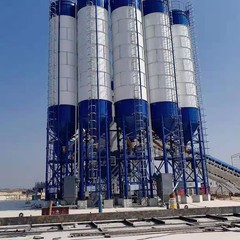
The production process of a gypsum board production line mainly includes key steps such as raw material preparation, batching, molding, drying, cutting to length, and post-processing. The entire process is highly automated, enabling efficient utilization of natural gypsum or industrial by-product gypsum (such as desulfurized gypsum).
1. Raw Material Preparation
Raw Material Source: Primarily building gypsum is used, but desulfurized gypsum, phosphogypsum, and other industrial by-product gypsum can also be used, achieving resource recycling.
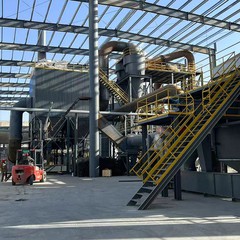
Pre-treatment: The raw materials are converted into usable hemihydrate gypsum powder (CaSO₄·0.5H₂O) through crushing, drying, and calcination processes, and then conveyed to the storage silo via a pneumatic conveying system for later use.
2. Ingredients and Mixing
Various auxiliary materials are precisely measured in proportion:
Pulp Preparation: Modified starch, retarder, pulp, water-reducing agent, and water are mixed in a hydrapulper to form a raw slurry, which is then stored in a slurry tank;
Foaming Agent: After being mixed with water, it is heated to above 35℃ to maintain its activity;
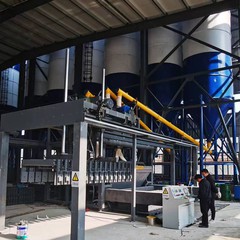
Accelerator and Gypsum Powder: Enter the silo via a lifting device.
All raw materials are mixed in a mixer to form a uniform gypsum slurry. The entire process is regulated by an automatic control system to ensure stable proportions.
3. Molding
The upper and lower facing papers are unwound separately, automatically corrected, and scored before entering the molding machine;
The gypsum slurry is evenly spread on the lower paper and extruded in the molding machine to form a slab;
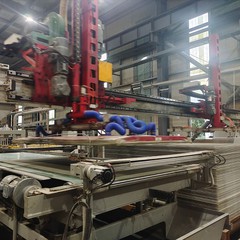
A hydraulic automatic molding machine (such as the LB-4 model), combined with silicone core tubes and pneumatic expansion technology, achieves high-precision molding and reduces breakage rate; Two gypsum boards can be molded at once, supporting production of various thicknesses from 60–150mm.
4. Solidification and Conveying
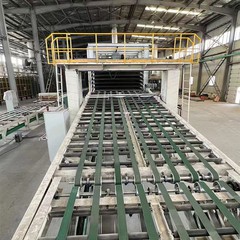
The slab undergoes initial and final solidification on a solidification belt. It is then conveyed to a fixed-length cutting machine via a conveyor roller conveyor for cutting to standard lengths (e.g., 2400mm, 3000mm). Cutting accuracy reaches ±0.3mm, ensured by laser ranging and an infrared control unit.
5. Drying
A hot air circulation drying system is used, typically divided into multiple temperature zones (e.g., 2–6 zones), precisely controlling the drying curve to avoid over-drying or under-drying. The heat source can be fuel oil, gas, or thermal oil furnaces; some systems are equipped with waste heat recovery devices for energy saving. Drying time is approximately 30–60 minutes, reducing the moisture content of the slab to below 0.5%.