

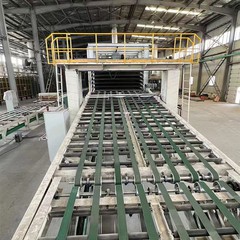
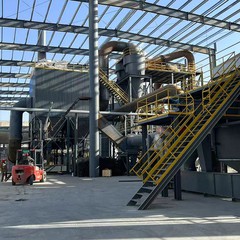
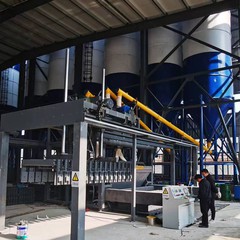
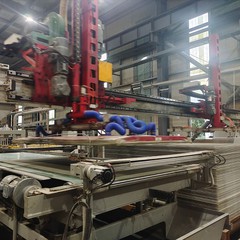
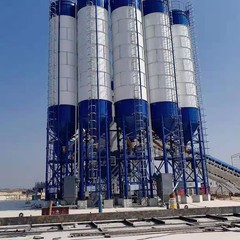



The technological process of a gypsum powder production line mainly includes five core stages: crushing, grinding, calcination, cooling, and packaging, achieving automated conversion from raw ore to finished powder. The process varies slightly depending on the type of raw material (natural gypsum or desulfurized gypsum), but the overall structure is clear and highly continuous.
1. Raw Material Preparation and Crushing Large gypsum ore (or power plant desulfurized gypsum) first undergoes preliminary processing:
Primary Crushing: A jaw crusher is used to crush the material into particles smaller than 30mm or ≤10mm;
Conveying and Feeding: The material is fed into the raw material silo via a bucket elevator or belt conveyor to supply material for subsequent processes.
This stage ensures uniform particle size to avoid clogging of subsequent equipment.

2. Grinding and Drying: Crushed gypsum enters a grinding mill for fine grinding, simultaneously removing some moisture.
Common equipment: Vertical grinding mill, Raymond mill, MTW European mill, etc.
Fineness range: Generally ground to 80–3000 mesh to meet various application requirements.
Simultaneous drying: A hot air system is used to control the feed moisture content to ≤15%, improving flowability and calcination efficiency.
Unqualified coarse powder is classified by an air classifier and returned to the mill for regrinding, forming a closed-loop cycle.
3. Calcination and Dehydration (Core Process) This involves heating and dehydrating dihydrate gypsum (CaSO₄·2H₂O) to convert it into hemihydrate gypsum (CaSO₄·0.5H₂O), i.e., building gypsum.
Mainstream Equipment:
Fluidized bed furnace: The most widely used type, it fluidizes the material, provides uniform heating, and maintains a temperature control of 120–200℃. Rotary kilns and vertical frying pans are also used in specific production lines.
Special Process for Desulfurized Gypsum: It requires a pre-drying system (such as a twin-shaft paddle dryer) to reduce surface moisture before entering the calcination stage.
The calcination process determines product performance, requiring precise temperature and residence time control.