

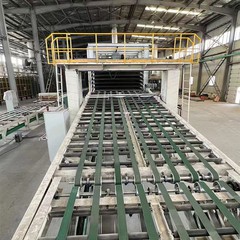
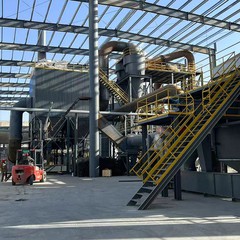
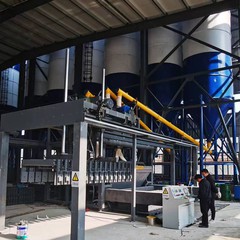
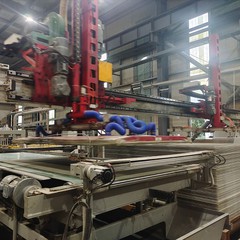
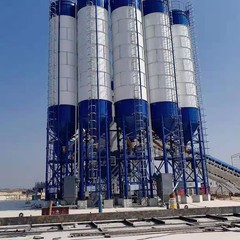
Assessing the stability of a gypsum block production line requires a comprehensive evaluation from three dimensions: the reliability of equipment parameters, the continuity of automation, and the technological maturity of mainstream brands. The core is to assess its ability to maintain high efficiency, low failure rate, and high yield over long-term operation.
Assessing Stability Through Key Equipment Parameters
Molding Cycle and Production Cycle Consistency
Highly stable equipment should have a molding cycle controlled at 6–8 minutes/mold (i.e., 6–8 molds per hour), with fluctuations not exceeding ±10%.
The number of molded blocks should be 8–16 per batch, with a large number of mold cavities and uniform material distribution to reduce batch variations.
Hydraulic System Performance
The central hydraulic station should provide dual-pressure switching capability of 300 bar high pressure and 150 bar low pressure to prevent slurry blockage of the mold cavities.
The maximum ejection force should reach 1350 kN to ensure smooth demolding and avoid block cracking or mold jamming due to insufficient pressure.
Mold Precision and Durability
The molds are made of alloy steel with hard chrome plating and mirror polishing, achieving a surface roughness ≤0.1μm and a lifespan exceeding 50,000 cycles.
Dimensional errors are controlled within ±1mm, ensuring block interchangeability and construction quality.
Ingredient and Mixing Precision
The water metering device has a volume of 450L, an adjustment range of 200–450L, and an accuracy of ±1%; the powder weighing capacity is 500kg, with an error ≤0.5%.
A dual high-speed paddle mixer (800L tank) ensures uniform slurry production, preventing segregation and strength fluctuations.
Energy Consumption and Temperature Control Stability
A rated power between 7.5–18.5kW is optimal; excessively high power may cause overheating, while excessively low power may affect continuous operation.
The drying system features a temperature-controlled heating chamber and drying chamber working in tandem, controlling the temperature difference within ±3℃ and shortening the drying cycle.