

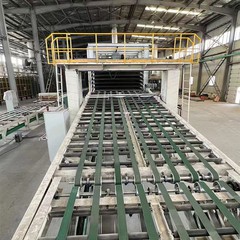
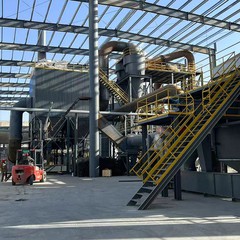
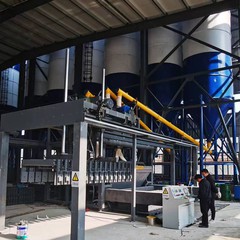
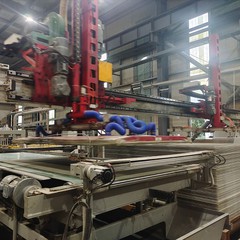
The higher the level of automation, the lower the production cost of gypsum board, mainly reflected in a significant reduction in labor, energy consumption, and scrap rate.
From current production practices, automation upgrades can systematically optimize the cost structure:
Significantly Reduced Labor Costs: Fully automated production lines, through PLC control, robotic loading and unloading, and intelligent packaging systems, reduce the number of manual intervention points from more than 5 in semi-automatic lines to less than 3, and the number of operators per line from 8-10 to 2-3. Based on 300 days of operation per year and an average wage of 80,000 yuan per person, this translates to annual savings of over 480,000 yuan in labor costs.
Increased Raw Material Utilization and Reduced Waste: Automated systems precisely control the proportions of raw materials (such as gypsum powder, water, and additives), and, combined with infrared ranging and dynamic feedback adjustment, keep mixing errors within ±1%, reducing raw material waste by approximately 12%-15% compared to manual operation. Meanwhile, a 93% bubble elimination rate and ±0.3mm cutting accuracy significantly reduce the defect rate, achieving a product qualification rate of over 98%.
Effective Energy Consumption Control: The intelligent temperature-controlled drying system automatically adjusts hot air circulation based on ambient temperature and humidity. Combined with a waste heat recovery device, gas consumption per ton of sheet can be controlled within 12m³, and overall electricity consumption is ≤25kWh, saving approximately 20% more energy than traditional production lines.
Superior Long-Term Maintenance Costs: Although the initial investment for a fully automated line is higher (generally over 1 million RMB), the equipment pre-maintenance system and fault self-diagnosis model reduce equipment downtime by 60%, improve repair response time, and typically achieve a payback period of 3-5 years.
In contrast, while semi-automatic or manual production lines have lower initial investments (60,000-150,000 RMB), they rely heavily on manpower, have high energy consumption, and high scrap rates, resulting in higher overall long-term operating costs.