

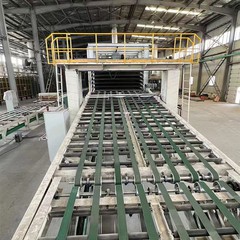
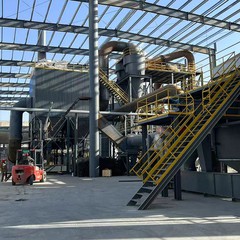
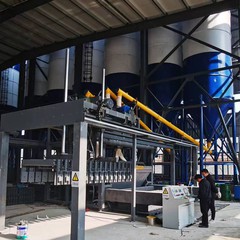
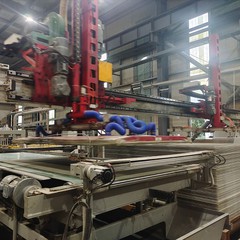
The core challenges of automating the control of a gypsum block production line mainly lie in poor adaptability to multiple operating conditions, strong system coupling, delayed fault response, and insufficient intelligence, affecting production efficiency and product quality stability.
Poor Adaptability to Multiple Operating Conditions: Production lines often need to cope with complex operating conditions such as different product specifications, fluctuations in raw material composition (e.g., changes in the purity of desulfurized gypsum), and changes in environmental temperature and humidity. Traditional control systems have fixed parameters, making it difficult to dynamically adjust process cycle time and control strategies, resulting in low changeover efficiency and increased defect rates.
Strong Coupling and Disturbance Propagation Between Processes: Processes such as batching, mixing, molding, and demolding are closely interconnected. Even minor disturbances in any stage (e.g., uneven material supply, vibration duration deviations) can be amplified through system coupling, triggering a chain reaction that causes the entire line to shut down or batch defects.
Insufficient Fault Diagnosis and Response Capabilities: Although the PLC system has basic alarm functions, it lacks intelligent diagnostic capabilities for complex faults (such as internal leakage in the hydraulic system and sensor drift), relying on manual troubleshooting. Common problems such as insufficient pneumatic system pressure and mechanical structure jamming, if not addressed promptly, can easily lead to prolonged downtime.
Lack of Intelligent and Self-Optimization Capabilities: Most production lines remain at the "automation" stage rather than the "intelligent" stage, lacking data-driven self-learning and parameter optimization capabilities. For example, they cannot automatically adjust the paste ratio or holding time based on real-time quality inspection feedback, hindering further improvements in product consistency.
High Human-Machine Collaboration and Maintenance Complexity: Highly integrated systems require a high level of professional expertise from operators and maintenance personnel. The application of new technologies such as AR maintenance and intelligent cloud services is not yet widespread, limiting the efficiency of on-site fault handling.