

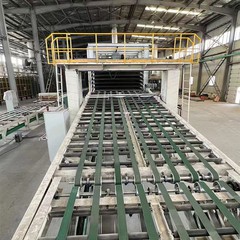
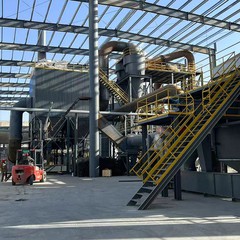
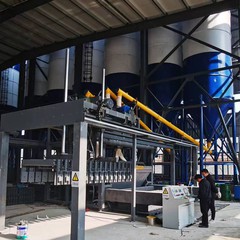
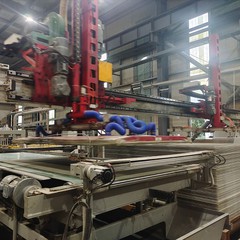
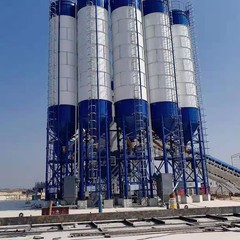
The construction process of a cement mortar mixing plant mainly includes key steps such as raw material preparation, metering, mixing, and discharging. The core is to ensure accurate mix proportions and uniform mixing.
Raw Material Preparation
Cement should be ordinary Portland cement of grade 32.5 or higher, fresh and free of lumps; sand must be sieved to control mud content; water should be clean and free of impurities. Admixtures (such as water-reducing agents and accelerators) should be prepared according to the designed dosage and have qualified certificates.
Metering and Feeding
All raw materials must be accurately measured by weight. Allowable deviations: cement, water, and admixtures ±1%, sand ±2%.
The recommended feeding sequence is: aggregate → cement → sand → water. If admixtures are added, liquid admixtures should be added together with water, and powdered admixtures should be added together with cement.
Mixing Process
Before mixing, add water and run the mixer empty to rinse it, then drain off any excess water.
The mixing time, starting from the addition of all materials, should generally be no less than 90 seconds; when admixtures are added, this should be extended by at least 30 seconds.
Use mixing equipment with automatic metering as a priority; a mix proportion sign should be displayed on-site, and a designated person should supervise the material addition.
Quality Control
The slump and workability of the concrete leaving the mixer must be checked; adjustments must be made if they do not meet requirements.
The slump should be checked at least twice per shift to ensure it meets construction requirements.
In areas where on-site mortar mixing is prohibited (such as Guangzhou and Zhuhai), pre-mixed mortar must be used.
Cleaning and Maintenance
After each construction period, promptly clean any residual mortar inside the mixer to prevent clumping and affecting future use.