

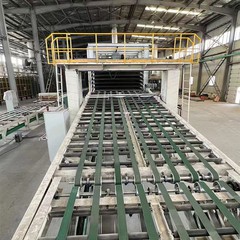
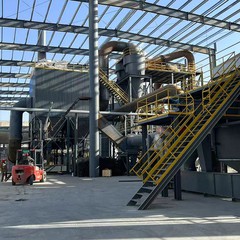
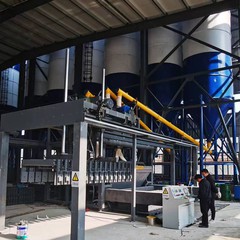
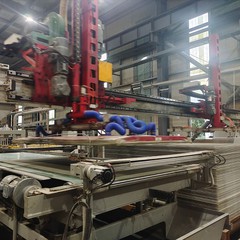
Choosing a suitable gypsum block production line requires comprehensive consideration of capacity requirements, automation level, equipment parameters, and performance differences among mainstream brands to match the actual production scale and investment budget.
How to Choose a Suitable Gypsum Block Production Line?
Define Capacity Targets
Small projects (under 100,000 sq m per year): Semi-automatic or simple production lines are suitable, offering low investment and flexible operation.
Medium-to-large projects (100,000–500,000 sq m per year): Fully automatic production lines are recommended, such as units with an annual capacity of 300,000–500,000 sq m, supporting continuous operation and reducing labor costs.
Focus on Core Equipment Parameters
Molding Cycle: Shorter cycles result in higher efficiency; advanced equipment can achieve 10 seconds per mold.
Mold Precision and Lifespan: The surface roughness of the mold cavity should be ≤0.1μm, using hard chrome plating + mirror polishing to ensure precise block dimensions.
Automation Level:Prioritize models integrating PLC control, automatic batching, vacuum dehydration, and intelligent palletizing to improve production stability.
Energy Consumption and Environmental Protection: Rated power is recommended to be between 7.5–240kW, depending on scale; the equipment should support the utilization of industrial by-product gypsum such as desulfurized gypsum and phosphogypsum, aligning with green building materials guidelines.
Mold Release Method and Product Type Matching:
Solid Block Line: Uses hydraulic ejection or open/close molds, with an efficiency of 6–8 molds/hour.
Hollow Block Line: More complex structure, slightly lower efficiency, 4–5 molds/hour.
Changeable Mold Cavity Design Supports Multi-Specification Production (e.g., 666×500×80 to 666×500×180mm), Enhancing Production Line Flexibility.
Plant and Installation Conditions: Typical light steel structure plant dimensions are 18×12×8 meters; equipment occupies approximately 30㎡; AGV transport channels and maintenance areas must be reserved.