

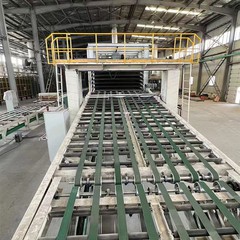
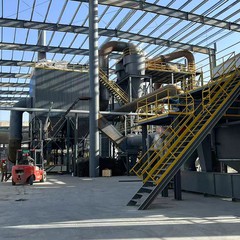
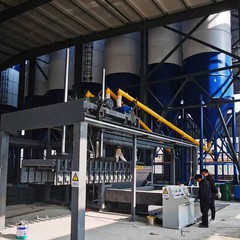
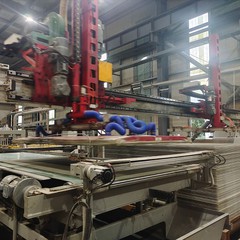



If you’re in the construction materials industry, you’ve likely wondered how precision gypsum blocks go from a wet, moldable slurry to a durable, dimensionally stable building component that meets stringent project requirements. As a supplier specializing in modern gypsum production technology, our Precision Gypsum Block Line is engineered with drying as a core, carefully calibrated step—one that directly impacts the block’s strength, shape accuracy, and long-term performance. Unlike outdated, inefficient drying methods that often lead to warping, cracking, or inconsistent moisture levels, our integrated drying process is tailored to preserve the precision and quality that make our blocks ideal for load-bearing and interior wall applications. Let’s break down exactly how this process works, why it matters, and how it aligns with the full range of high-strength gypsum block solutions we offer.
First, it’s important to set the context: the drying step in gypsum block production is not a one-size-fits-all task. Wet gypsum blocks, fresh from the molding stage, typically carry a moisture content of 18–22% by weight. If exposed to extreme heat too quickly, the surface will harden and trap moisture inside, leading to internal cracks. If dried too slowly, the blocks can deform, shrink unevenly, or fall behind production timelines. Our Precision Gypsum Block Line solves this by using a staged, controlled drying tunnel system, complemented by advanced sensor technology and air circulation design. This is just one feature that sets our line apart from basic production setups—especially when compared to specialized options like the High-strength Load-bearing Gypsum Block Production Line, which requires even more precise drying to meet structural standards for multi-story buildings.
The drying process begins immediately after the demolding stage, and it unfolds in four distinct, sequential phases. Each phase is optimized to target specific moisture levels in the block, adjust air conditions accordingly, and ensure dimensional accuracy remains intact. Let’s walk through each step in detail.
Phase 1: Pre-Drying (Conditioning Phase)
Right after demolding, wet gypsum blocks are still soft, with a fragile outer layer that can easily smudge or deform if handled roughly. The first phase of drying focuses on gradual conditioning, rather than rapid heat application. Within this phase, the blocks are moved through a dedicated section of the production line at a slow, consistent speed—usually 0.5 meters per minute—where the air temperature is kept at 45–50°C, and relative humidity is set to 70–75%. This low, stable heat slowly starts to evaporate surface moisture, while the high humidity prevents the outer layer of the block from drying too fast. If the surface dries prematurely, it will shrink before the internal moisture has a chance to escape, leading to warping or hairline cracks that compromise the block’s integrity.
This phase also plays a key role in preparing the blocks for subsequent steps: by the end of pre-drying, their moisture content drops to 12–14%, and their outer layer is firm enough to handle without risk of damage. For operators, this phase is monitored in real time by a network of sensors placed along the drying tunnel, which adjust temperature and humidity if any blocks show inconsistent drying rates. For context, this level of precision is critical for lines like the Modular High-strength Gypsum Block Production Line, where small variations in drying can lead to misalignment during later modular assembly.
Phase 2: Primary Drying (Core Moisture Removal)
Once the blocks have moved through pre-drying, they enter the primary drying phase, which is the longest and most critical step in the process. Here, the air temperature is increased gradually to 60–70°C, and relative humidity is lowered to 40–50% to speed up moisture evaporation without stressing the block’s internal structure. The key here is air circulation: our Precision Gypsum Block Line uses variable-speed fans that blow air both horizontally and vertically across the blocks, ensuring every surface is exposed to consistent, moving heat. Stagnant air would create hot spots on the block, leading to uneven drying, while too much wind can cause the surface to dry too fast—another risk we mitigate through calibrated fan speeds.
During primary drying, the blocks’ internal moisture (which accounts for most of the 18–22% initial moisture content) starts to evaporate and escape through the block’s porous structure. This phase continues until the moisture content drops to 4–6%, a level that’s standard for gypsum blocks used in construction. What makes our line different from traditional drying systems is that we don’t rely on fixed temperature settings for the entire tunnel. Instead, the sensors track the moisture level of blocks as they move, adjusting heat and air flow in each section of the tunnel to ensure uniform drying. This is especially important for heavy-duty applications, which is why our Heavy Duty Gypsum Block Line includes a longer primary drying section than standard lines, to accommodate the thicker, larger blocks used in load-bearing walls.
Phase 3: Final Conditioning (Stabilization Phase)
Even after primary drying, gypsum blocks often have minor internal moisture variations—some areas may be slightly wetter than others, or there could be residual moisture trapped in small pores. The final conditioning phase is designed to stabilize the blocks, ensuring their moisture content is consistent across every block and within the industry’s required range of 3–5%. This phase runs at a slightly lower temperature (40–45°C) with moderate humidity (55–60%), and the blocks move at a slower speed to allow any remaining moisture to escape evenly.
During this phase, the blocks also acclimate to ambient air conditions before exiting the production line, which prevents them from absorbing moisture later when transported or stored. If a block is too dry when it leaves the line, it will absorb moisture from the air, leading to swelling and dimensional changes over time; if it’s too wet, it will shrink as it dries, leading to fit issues on construction sites. This stabilization step is why our Precision Gypsum Block Line produces blocks with a dimensional tolerance of ±0.5mm, a level of accuracy that’s impossible to achieve with uncontrolled, batch-style drying. For full automation, our Full-automatic High-strength Gypsum Block Production Line integrates this conditioning phase with automatic sorting, so blocks that don’t meet moisture standards are re-routed back to the drying tunnel for additional processing—reducing waste and improving yield.
Phase 4: Quality Verification (Post-Drying Inspection)
Once blocks exit the drying tunnel, the process doesn’t end there. Our Precision Gypsum Block Line includes an automatic quality inspection station that checks both moisture content and dimensional accuracy. Near-infrared sensors scan each block to measure moisture, ensuring it’s within the 3–5% range, and laser sensors check dimensions to confirm they match specifications. Any blocks that fail are automatically diverted for reprocessing, a feature that cuts down on human error and ensures only high-quality blocks reach customers. This step is crucial for maintaining the line’s precision, as even a small variation in moisture can affect the block’s strength. Studies show that gypsum blocks with a moisture content above 6% have 20–30% lower compressive strength than blocks dried to the correct level, making precise drying non-negotiable for structural applications.
Now, you might be wondering how this process compares to other gypsum production lines on the market. Many competitors use single-stage drying, where blocks are exposed to high heat immediately after demolding, leading to common issues like surface cracking, uneven shrinkage, and low yield. Our staged, sensor-driven approach addresses these issues by balancing speed and care, ensuring that every block retains the structural integrity and precision required for modern construction. For example, the high-strength load-bearing blocks produced on our line need to support vertical loads, so the drying process must strengthen the gypsum’s crystalline structure without creating internal stress. This is why our High-strength Load-bearing Gypsum Block Production Line is built with a reinforced drying tunnel that uses uniform air flow, preventing any weak points that could lead to block failure.
For buyers considering a gypsum block production line, the drying process is often the most overlooked (but most impactful) factor in long-term success. A poorly designed drying system can lead to 15–20% of blocks being rejected during quality checks, increasing production costs and delaying delivery. Our Precision Gypsum Block Line reduces that rejection rate to less than 2%, thanks to its customized drying stages and real-time monitoring. Whether you’re a small business looking to start gypsum block production or a larger company seeking to upgrade your existing line, our range of solutions—from modular lines ideal for small-scale operations to full-automatic lines for high-volume production—are designed to optimize every step, including drying.


If you’re looking to upgrade your gypsum block production process or start a new line, our team has the expertise to help you choose the right solution for your needs. Our lines are built with industry-leading technology, and our drying processes are calibrated to meet both local and international construction standards. To learn more about how our Precision Gypsum Block Line or any of our specialized production lines can benefit your operation, connect with our team to discuss your requirements and request a customized consultation.
References
- ASTM International. (2020). Standard Test Methods for Moisture Content of Gypsum Products. ASTM C370-20. West Conshohocken, PA: ASTM.
- World Gypsum Association. (2019). Gypsum Block Production: Best Practices for Drying and Quality Control. Washington, D.C.: World Gypsum Association.
- Zhang, L., & Wang, H. (2021). Optimization of Drying Processes for Gypsum Building Materials. Journal of Construction Materials, 24(3), 112–125.
- European Gypsum Association. (2022). Technical Guidelines for High-Strength Gypsum Block Production. Brussels: European Gypsum Association.
- Industrial Automation Association. (2020). Sensor-Based Monitoring for Drying Processes in Construction Material Production. Journal of Industrial Automation, 18(2), 45–58.